December 02, 2025
7 min read
Key takeaways:
- Diabetology was recently recognized as a unique taxonomy classification.
- A board certification exam allows diabetologists to be formally recognized.
- Becoming certified can help streamline billing.
Diabetology recently received formal recognition as a distinct physician specialty, which represents a milestone for physicians focused primarily or exclusively on diabetes care.
According to the American College of Diabetology, or ACD, diabetology is a specialty “focused on the full continuum of diabetes care — encompassing diagnosis, treatment, prevention, technology integration, education and cardiometabolic management.”

“While it intersects with endocrinology, primary care and public health, diabetology is uniquely defined by its depth and focus on diabetes alone,” the ACD press release said. “The taxonomy is designed to complement the work of endocrinologists and primary care providers, not compete with them.”
Diabetologists can formally validate their expertise through ACD’s board certification exam, which offers several benefits like streamlined billing, practice differentiation and opportunities for networking, according to the organization.
Registration for the exam will open in June 2026.
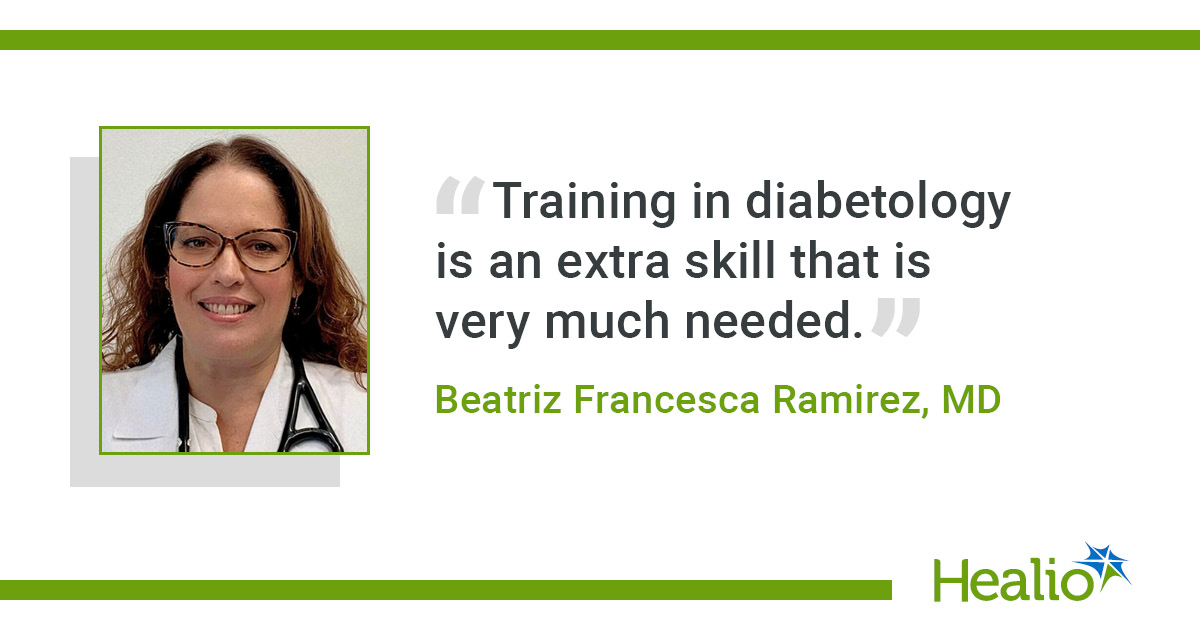
Healio spoke with Beatriz Francesca Ramirez, MD, a clinical associate professor of endocrinology at East Carolina University and chair of ACD’s board exam, to learn more about the process of the exam’s creation, how certification streamlines billing and more.
Healio: Can you highlight some of the areas included in the ACD’s board certification exam?
Ramirez: It’s very similar to what you see in the internal medicine, family medicine and endocrinology boards’ diabetes section. The area that has the most weight, which is where diabetologists will be different, is the management of different medications — everything about pharmacology, pharmacokinetics, pharmacodynamics and technology use.
Normally, internal medicine or family medicine physicians don’t receive training in diabetes technology. But diabetes fellows who have gone through a fellowship program will get training on insulin pumps and continuous glucose monitoring devices. They are at the forefront of the multiple therapies still in the pipeline that will be available soon.
Diabetes and obesity correlate together, as do multiple other comorbidities, so another heavy area of the test requires the doctor to know not only how to manage diabetes, but also how to manage the complications of diabetes and potential adverse outcomes of having diabetes in the future.
Healio: Can you describe the process for formulating questions? Do you plan on updating the exam in the future?
Ramirez: It is a huge ordeal. I am the chair of the item-writing committee. We have some physicians who work toward developing new questions and others who review the questions in the question bank.
New guidelines come out every year, so some of the questions will no longer be valid, and we have to upgrade those. Because the test started a few years back, we have not had to go in depth and change the entire question bank, but that is a work in progress. We work closely with the National Board of Osteopathic Medical Examiners (NBOME), and we set up item-writing workshops where we dedicate the day to training the new physicians collaborating in the process of writing questions. They need to be taught how to write valid questions. With multiple choice questions, we make sure only one of the answers is correct, not multiple. We go through the process of creating questions, and the NBOME helps us determine which questions need reviewing and [ensures] that they are clear and easy to read. Then the questions are published and they are reviewed again. Once a group takes the test, the statistical validation comes into play.
There are some questions that we determine tested poorly because the people who did great on the test had the question wrong, or everyone had it wrong. We are able to assess whether the question tested what we wanted to test and not make the person confused.
Very recently we had a group of expert physicians in the field of diabetology go over the questions, rate them and determine if they were testing appropriately. At this point, we have diplomates, and the more people who take the test, the more statistically valid the test will be.
It is a whole process. It is a work in progress. This is something we work on, not only at the time when diabetologists will take the board exam, but something that is going on all year long. It will get more and more difficult as we develop more questions and we need to update those questions on a regular basis.
Healio: How does the recognition of diabetology as a specialty, in addition to the exam, help streamline billing?
Ramirez: I don’t know what the future holds, but that has been an ordeal in the past. You have these physicians who have received expert training in diabetes and, in many fellowships, work alongside endocrinology fellows as well. So, you have both endocrinology fellowships and diabetology fellowships working together under endocrinologists. We train them, and then the difficulty has been for them to find a path to take care of patients with diabetes. It’s ridiculous because 11.6% of the population of the United States has diabetes and that translates into more than 38 million people. There are patients enough for all of us.
Having said that, at my institution, there has been a problem hiring diabetologists, because they don’t know if they should bill as primary care or submit their billing as endocrinologists. Some states say they are endocrinologists, and they work under endocrinology taxonomic code. But where I practice, it is as PCPs and, as such, it’s a problem for them to find a niche where they can be dedicated to caring for patients with diabetes, which is what they’re specialized in doing. Hopefully, this taxonomic will help with the billing and with the recognition of diabetology as a subspecialty.
Healio: What are some other notable benefits of being ACD certified?
Ramirez: First of all, you get to use the taxonomic code. Second, you are recognized as somebody who has been properly trained to manage patients with diabetes. When I say that, I don’t mean to be exclusive. I recognize that there are many PCPs who are passionate about diabetes care, and we want to include everyone.
The difference is that diabetologists can put a patient on an insulin pump, and that is training that you only receive when you practice at an endocrinology or diabetology practice. We have helped create more diabetes fellowships, but when I started, there were only two of them. The diabetology fellowship here, where I work, started in 2004. As the ACD has become a reality, we have more [fellowships] in the country for the 38.4 million people [with diabetes]. It is very different. The skills that a PCP has — mostly because of exposure to technology — are very different than diabetologists, especially because a PCP not only takes care of diabetes, but they also take care of many other conditions. A person who trains in diabetology has the opportunity to focus solely on diabetes, and that is not an opportunity that many residency programs, whether it’s internal medicine or family medicine or others, will have. It is an extra skill they get by investing in one more year of training.
Healio: Once a physician is certified, how often might patients need to go see an endocrinologist when they have a diabetologist as their provider?
Ramirez: If you have a diabetologist as your provider, and the only endocrine problem you have is diabetes, you don’t need to see an endocrinologist. That is the point — by creating more diabetologists, we’re hoping to improve access to care, which is a problem. In endocrine practices, for example, it takes 6 to 8 months to get an appointment. And remember, this is not just diabetes, there are multiple endocrine conditions like pituitary tumors and thyroid cancers and whatnot, so you may even have endocrinologists who don’t see patients with diabetes. In terms of seeing a patient in the office, it takes longer to see a patient with diabetes than it does to see them for other endocrine conditions. That is also something that must be recognized. It is very intensive to see a patient with diabetes, connect with them, get them to agree with your plan and want to invest in their care because it means changing lifestyles — it means going to see a dietitian. It is a lot when it comes to managing a patient with diabetes.
If a patient has a diabetologist, it’s the same as having an endocrinologist, because the training that an endocrinologist gets is the same training a diabetologist will get. It’s just that the diabetologist does not focus on thyroid, pituitary, adrenal or other endocrine conditions. It is solely based on diabetes, and they have the ability to use the technology to the patient’s advantage — to use insulin pumps and more complicated treatments. As a diabetologist, how to use the different drugs that come out and be at the forefront and updated on all of them is an art you have to master.
Healio: Anything else to add or emphasize?
Ramirez: I would like to make sure that physicians understand that diabetes is a global disease. There are enough patients for everyone, and I feel that training in diabetology is an extra skill that is very much needed.
I also want to underline that the ACD is all about inclusion, and we have two different paths to certify physicians. We have the fellowship training path and then we have the CME. Very experienced physicians may not have had the opportunity to train as a diabetologist, because there were few programs in the country. Now there are more, but there are physicians who need to be recognized with a lot of experience in diabetes, and they deserve a path to become certified. That’s there for them on our website.
Lastly, we have a lot of organizations that agree with what we’re doing, and we have their support, like the American Diabetes Association and Helmsley Foundation. They have helped us create more programs in the country. We need to improve access to care for all patients and we really need to try to tackle diabetes, which is a monster right now. Hopefully, if more people know about this they will want to train, become certified and help more patients.
For more information:
Beatriz Francesca Ramirez, MD, can be reached through Jensen Kissner, account executive at Largemouth Communications, at jkissner@largemouthpr.com.
Sources/Disclosures
Source:
Healio Interviews
References:
Disclosures:
Healio could not determine Ramirez’s relevant financial disclosures at the time of publication.

Ask a clinical question and tap into Healio AI’s knowledge base.
- PubMed, enrolling/recruiting trials, guidelines
- Clinical Guidance, Healio CME, FDA news
- Healio’s exclusive daily news coverage of clinical data