





December 24, 2025
3 min read
Key takeaways:
- Chronic respiratory therapies included inhaled antibiotics, hypertonic saline, dornase alfa and oral azithromycin.
- The proportion of patients taking zero or one chronic therapy rose after triple therapy use.
Among pediatric and adult patients with cystic fibrosis, the average number of chronic respiratory therapies used fell after starting triple therapy, according to results published in Journal of Cystic Fibrosis.
“A shared goal among clinicians and people with cystic fibrosis (CF) is to maintain long-term health while minimizing treatment burden,” Scott D. Sagel, MD, PhD, professor of pediatrics-pulmonary medicine at the University of Colorado Anschutz School of Medicine and director of the University of Colorado Cystic Fibrosis Center, told Healio.

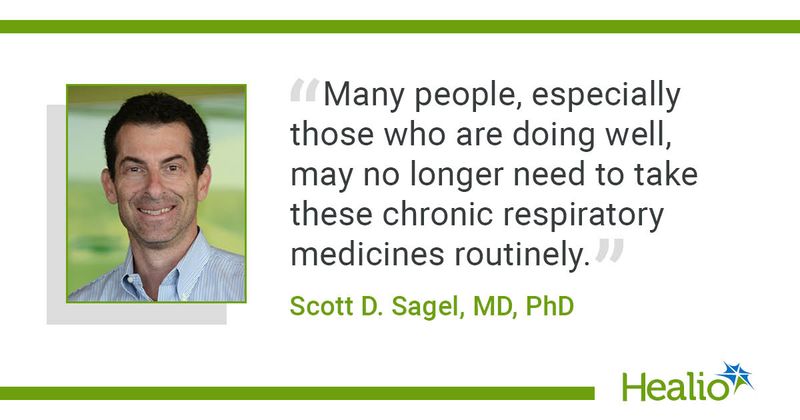
“Our findings suggest that many people, especially those who are doing well, may no longer need to take these chronic respiratory medicines routinely,” he said.
In a post-hoc analysis of the prospective, multicenter, observational PROMISE study, Sagel and colleagues assessed 603 U.S. patients aged at least 6 years with CF receiving elexacaftor/tezacaftor/ivacaftor (ETI; Trikafta, Vertex Pharmaceuticals) therapy for 36 to 54 months to determine how self-reported use of four chronic respiratory therapies — inhaled antibiotics, hypertonic saline, dornase alfa and oral azithromycin — changes with ETI use.
“Prior to the approval of Trikafta, people with CF were having to do many daily treatments including medications to maintain lung health, which include inhaled antibiotics, hypertonic saline, dornase alfa and oral azithromycin,” Sagel said. “Reducing treatment burden has been a priority for people with CF and their clinicians.”
This study population included 479 patients aged 12 years or older and 124 patients aged 6 to 11 years.
Among those in the older age group, the mean total number of daily therapies before starting ETI therapy was 2.6. At the 54-month mark of ETI therapy, this number significantly fell to 1.4.
Researchers noted that this drop in chronic therapy use was seen for each of the four therapies through the proportion of adolescents and adults using each one before ETI vs. at the 54-month mark of ETI: inhaled antibiotics (50.7% vs. 18.6%), hypertonic saline (75.6% vs. 44.1%), dornase alfa (87.9% vs. 50.5%) and oral azithromycin (48.9% vs. 30.5%).
Further, 53.4% of adolescents and adults were taking zero or one chronic therapy at the 54-month mark of ETI therapy, which was a significant improvement from the 13.8% of patients who reached this before starting ETI.
Similar to above, the younger age group had a significantly smaller mean number of the four therapies at the 36-month mark of ETI therapy vs. before starting ETI (1.3 vs. 1.9).
Based on the proportions of children using each chronic respiratory therapy before vs. 36 months after ETI use, researchers reported reductions in the prevalence of inhaled antibiotics (11.3% vs. 4.1%), hypertonic saline (67.7% vs. 49.5%), dornase alfa (84.7% vs. 55.7%) and oral azithromycin (28.2% vs. 18.6%).
Additionally, at 36 months, 58.8% of children were taking zero or one chronic therapy, demonstrating a significant improvement from the 30.6% of patients who met this criterion before starting ETI.
Across multiple subgroups (baseline age strata, sex, prior CF transmembrane conductance regulator modulator use and percent-predicted [pp] FEV1 at baseline), researchers continued to find that use of all four therapies was reduced following the start of ETI therapy.
When comparing participants on at least two therapies at the 36- or 54-month mark of ETI with participants on less than two therapies at these times, no differences were found in mean improvements in ppFEV1. This was also the case when researchers evaluated mean changes in respiratory symptoms between the two groups.
“While it was not totally surprising or unexpected, we were reassured to find that average improvements in lung function and average changes in respiratory symptoms post-ETI did not differ between participants who remained on [greater than or equal to] two therapies and participants taking [less than] two therapies,” Sagel told Healio.
Reflecting on the study’s findings, Sagel said there are some reasons for caution.
“People with CF who stopped taking these medicines had better lung function and were less likely to be infected with P. aeruginosa, and our study may not fully capture longer-term consequences of stopping these medicines,” he told Healio.
“Also, we did not ask study participants why they stopped taking these medicines, and whether it was by personal choice or through shared decision-making with their CF clinician,” Sagel continued.
Looking ahead, Sagel told Healio there are more questions on this topic that need to be investigated.
“Future studies will need to address whether taking these respiratory therapies intermittently during respiratory illnesses are helpful and whether mechanical forms of airway clearance (eg, positive expiratory pressure devices, high frequency chest wall oscillation) remain necessary for people who no longer depend on inhaled mucus-thinning medications,” Sagel said.
For more information:
Scott D. Sagel, MD, PhD, can be reached at scott.sagel@childrenscolorado.org.

Ask a clinical question and tap into Healio AI’s knowledge base.
- PubMed, enrolling/recruiting trials, guidelines
- Clinical Guidance, Healio CME, FDA news
- Healio’s exclusive daily news coverage of clinical data