

December 30, 2025
2 min read

Key takeaways:
- Social welfare policies may combat disparities and reduce the prevalence of arthritis-related joint pain.
- Medicaid generosity and minimum wage show beneficial impacts.
State-level social welfare policies may address disparities in arthritis-related joint pain prevalence and education for patients from certain geographic areas, according to data published in the Journal of Pain.
“Because macro-level policies shape material resources, access to care, stress and health behaviors, state welfare policies are likely to influence who develops moderate to severe arthritis-related joint pain,” Rui Huang, a PhD candidate in the department of sociology and criminology at the University at Buffalo, told Healio. “By treating states and their welfare programs (eg, Medicaid, minimum wage) as structural determinants of pain, our study shifts attention from solely individual-level risk factors to policy levers that could prevent pain and narrow disparities at the population level.”

Huang and colleagues used a multisource panel dataset to assess a nationwide cohort of adult patients with arthritis-related joint pain from rheumatoid arthritis, gout, lupus or fibromyalgia. The researchers studied state-level welfare policies such as the Supplemental Nutrition Assistance Program, Earned Income Tax Credit, minimum wage, unemployment insurance and Medicaid generosity score. In addition, they assessed the impact of patient education level and geographic region on pain prevalence.
From 2011 to 2021, Huang and colleagues found joint pain prevalence rose from 10.5% to 11.6%, an increase representing 4.6 million adults nationally.
“The prevalence increased in most states, except for Montana, Wyoming, South Dakota and New York,” Huang said. “The largest increases were in Colorado, followed by Hawaii, Nebraska, Kansas and North Dakota.”
According to Huang, educational disparities in pain also increased in more than half of the states.
“The gap rose most in Colorado and decreased most in Pennsylvania,” she said. “Colorado and North Dakota exhibited sharp increases in both joint pain prevalence and educational disparities due to the notably high increase in joint pain prevalence among adults with less than a high school degree.”
According to the researchers, generous Medicaid programs were associated with decreased joint pain prevalence for the general population and adults with a low level of education.
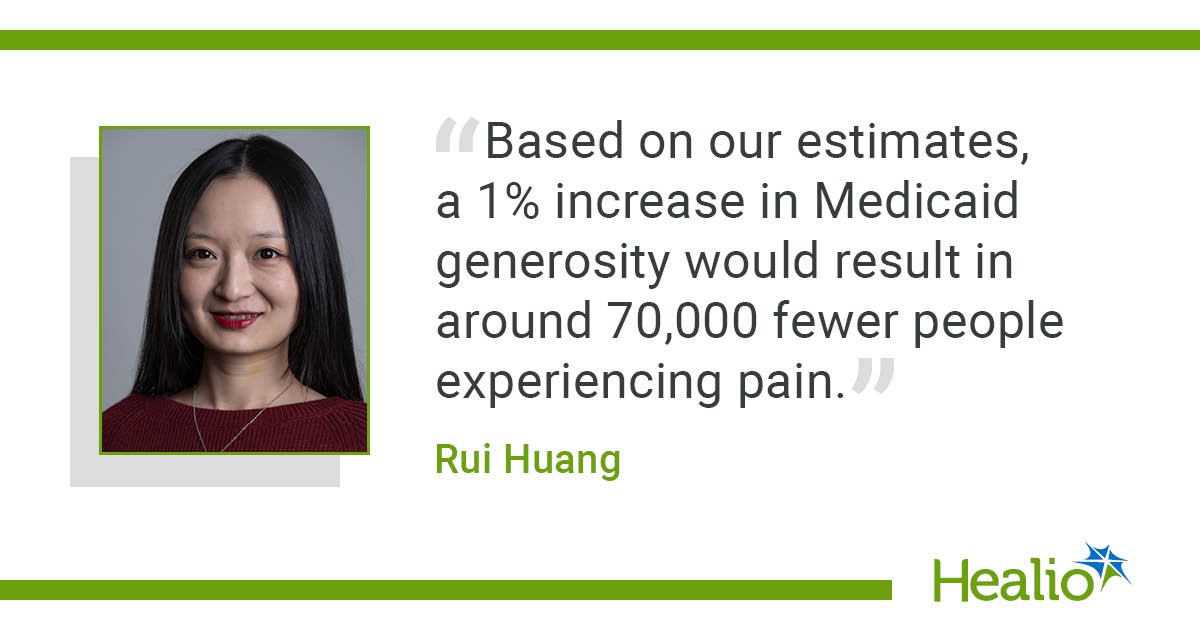
“Based on our estimates, a 1% increase in Medicaid generosity would result in around 70,000 fewer people experiencing pain,” Huang said. “Likewise, a 1% increase in minimum wage could potentially benefit around 68,000 individuals with a high school or college degree.
“In states with less generous Medicaid or low minimum wages, physicians may need to anticipate higher pain burdens among socioeconomically disadvantaged patients, particularly those with low education, and proactively screen for disabling pain as well as prioritize low-cost, accessible multimodal pain management strategies,” she added.
Overall, a public health approach to pain can be accomplished with great attention to social policies, especially for high-risk groups, according to Huang and colleagues.
“Pain prevention and management cannot be fully addressed within clinics alone,” Huang said. “They require ongoing collaboration between health systems, public health agencies and policymakers to design and evaluate policies that explicitly consider their downstream effects on health outcomes and embedded social inequalities.”
For more information:
Rui Huang can be reached at rhuang27@buffalo.edu.

Ask a clinical question and tap into Healio AI’s knowledge base.
- PubMed, enrolling/recruiting trials, guidelines
- Clinical Guidance, Healio CME, FDA news
- Healio’s exclusive daily news coverage of clinical data