

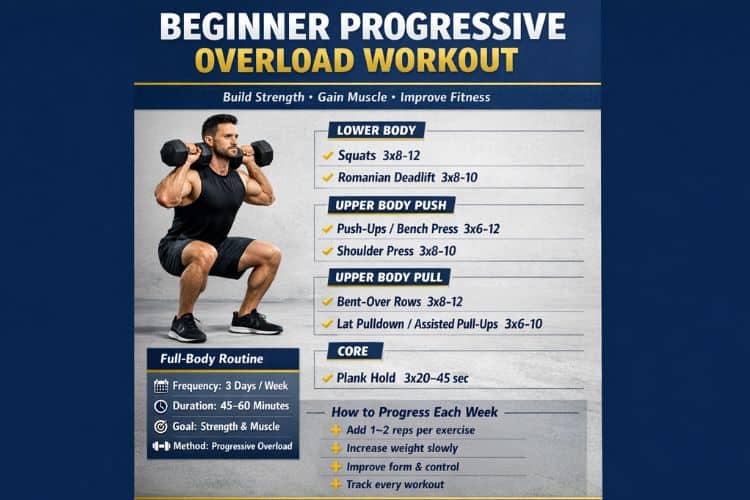

Starting a fitness journey can feel overwhelming, especially when you hear terms like progressive overload, volume, and intensity. Many beginners either train too lightly and see no results or push too hard and end up injured or burned out. The good news is that progressive overload is one of the simplest and safest training principles when applied correctly. A beginner progressive overload workout helps you build muscle, increase strength, burn fat, and improve confidence—without guesswork or extreme routines.
This guide breaks down everything you need to know about progressive overload for beginners, including how it works, why it matters, and how to follow a simple full-body workout plan that delivers results week after week.
What Is Progressive Overload?
Progressive overload is the gradual increase of stress placed on your muscles during training. Your body adapts to exercise by becoming stronger, but only if the challenge slowly increases over time. If you lift the same weight, perform the same reps, and train the same way every workout, your progress will eventually stall.
For beginners, progressive overload does not mean lifting heavy weights right away. Instead, it means small, manageable improvements that allow your muscles, joints, and nervous system to adapt safely.
Why Progressive Overload Is Perfect for Beginners
Many beginners assume they need advanced techniques or extreme workouts to see results. In reality, progressive overload is ideal for beginners because it promotes steady improvement while minimizing injury risk.
When applied correctly, progressive overload:
- Builds muscle efficiently
- Improves strength without overtraining
- Enhances joint and tendon resilience
- Creates long-term consistency
- Prevents plateaus early in your fitness journey
Beginners respond especially well to progressive overload because their bodies adapt quickly to new stimuli. Even small increases can produce noticeable gains.
How Progressive Overload Works for Beginners
Progressive overload can be applied in multiple ways. You do not need to increase weight every workout to make progress. Beginners benefit most from rotating between several progression methods.
Increase Repetitions
One of the safest ways for beginners to apply progressive overload is by adding reps. For example, if you perform 8 reps in week one, aim for 9 or 10 reps in week two using the same weight.
Increase Weight Gradually
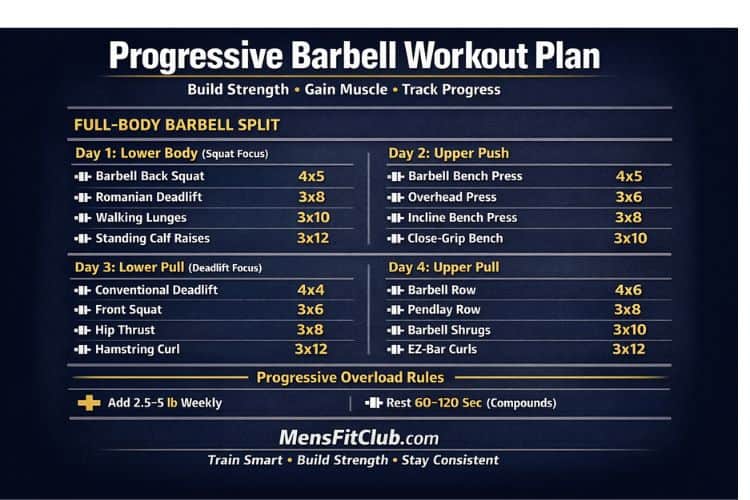
Once you can comfortably perform the upper end of a rep range, increase the weight slightly. Even a 2.5–5 lb increase is enough to stimulate progress.
Improve Exercise Control
Slower tempo, better form, and increased time under tension count as overload. Improving how you perform each rep strengthens muscles more effectively than rushing through movements.
Increase Training Volume
Adding an extra set to an exercise increases total workload. Beginners should do this sparingly and only when recovery feels manageable.
Beginner Progressive Overload Training Principles
Before diving into the workout plan, it’s important to understand the foundational principles that keep beginners progressing safely.
Focus on Full-Body Training
Full-body workouts allow beginners to train each muscle group multiple times per week without excessive fatigue. This leads to faster learning, better recovery, and balanced development.
Prioritize Compound Exercises
Compound movements train multiple muscle groups at once, making them more efficient for beginners. These exercises build coordination, strength, and confidence.
Train With Moderate Intensity
Beginners should finish most sets with 1–3 reps left in reserve. This prevents burnout while still stimulating growth.
Progress Slowly and Consistently
Progressive overload is a marathon, not a sprint. Small improvements performed consistently lead to impressive long-term results.
Beginner Progressive Overload Workout Structure
This beginner program uses a full-body split, performed 3 days per week, such as Monday, Wednesday, and Friday. This structure allows recovery days between workouts while maintaining training frequency.
Weekly Schedule Example
- Day 1: Full Body Workout A
- Day 2: Rest or Active Recovery
- Day 3: Full Body Workout B
- Day 4: Rest
- Day 5: Full Body Workout A
- Weekend: Rest or light activity
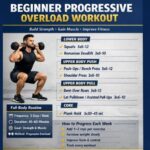
Beginner Progressive Overload Full-Body Workout
Warm-Up (5–10 Minutes)
Begin every workout with a light warm-up to prepare your muscles and joints.
Lower Body Exercises
Squats (Bodyweight or Dumbbell)
Squats build strength in the legs, glutes, and core. Beginners should focus on depth, balance, and control.
Progress by adding reps first, then adding light resistance.
Romanian Deadlifts (Dumbbell or Barbell)
This movement targets the hamstrings and glutes while teaching proper hip hinge mechanics.
Increase load slowly as form improves.
Upper Body Push Exercises Beginner Progressive Overload Workout
Push-Ups or Bench Press
Push-ups are excellent for beginners and can be modified to match strength levels.
Progress from incline push-ups to floor push-ups, then to weighted variations.
Overhead Shoulder Press
This exercise builds shoulder strength and upper-body stability.
Use dumbbells to allow natural shoulder movement.
Upper Body Pull Exercises Beginner Progressive Overload Workout
Bent-Over Rows
Rows strengthen the upper back, arms, and posture muscles.
Focus on squeezing the shoulder blades rather than pulling with the arms.
Lat Pulldowns or Assisted Pull-Ups
Pulling movements improve back strength and shoulder health.
Reduce assistance gradually as strength improves.
Core Training
Planks
Planks build core stability and protect the lower back.
- Sets: 3
- Time: 20–45 seconds
Progress by increasing time or improving posture.
How to Apply Beginner Progressive Overload Workout Week by Week
Progression should be planned and intentional. Beginners often make the mistake of changing too many variables at once.
Weeks 1–2: Learn the Movements
Focus on form, breathing, and consistency. Do not rush progression.
Weeks 3–4: Add Reps
Increase reps within the recommended range while keeping weights the same.
Weeks 5–6: Increase Weight Slightly
Once you hit the top of the rep range, add a small amount of weight and return to the lower rep count.
Weeks 7–8: Add Volume or Control
Introduce an extra set or slow down the tempo for added challenge.
Recovery and Adaptation for Beginner Progressive Overload Workout
Progressive overload only works when recovery is prioritized. Muscles grow during rest, not during workouts.
Sleep and Nutrition
Aim for 7–9 hours of sleep per night and consume enough protein to support muscle repair.
Rest Days Matter
Beginners should not train hard every day. Rest days allow muscles and joints to adapt to new stress.
Listen to Your Body
Mild soreness is normal, but persistent pain is not. Adjust volume or intensity when needed.
Common Beginner Mistakes With Progressive Overload Workout
Many beginners unintentionally slow their progress by making avoidable mistakes.
Increasing Weight Too Quickly
Jumping up in weight before mastering form increases injury risk and stalls progress.
Skipping Warm-Ups
Cold muscles are more prone to strain. A proper warm-up improves performance and safety.
Training to Failure Every Set
Beginners recover more slowly from failure training. Leave a few reps in reserve.
Ignoring Technique
Progressive overload without proper form limits results and increases injury risk.
How Long Until Beginners See Results?
Most beginners notice improvements within the first 2–4 weeks. Strength gains often appear before visible muscle growth due to neural adaptations.
Within 8–12 weeks, consistent progressive overload typically leads to:
- Increased strength
- Improved muscle tone
- Better posture
- Increased energy levels
- Higher confidence in the gym
Beginner Progressive Overload Workout Tips for Long-Term Success
Consistency is more important than perfection. Focus on showing up, following the plan, and making small improvements over time.
Track your workouts, record weights and reps, and celebrate progress—even when it feels small. Progressive overload rewards patience and discipline.
Why Progressive Overload Workout Is the Best Beginner Training Method
A beginner progressive overload workout removes confusion and replaces it with structure. Instead of guessing what to do each session, you follow a clear plan that builds strength safely and efficiently.
By focusing on gradual progression, proper form, and recovery, beginners can build muscle, burn fat, and develop lifelong fitness habits. Progressive overload is not just a training method—it is a mindset that ensures continuous improvement.
If you’re just starting your fitness journey, this approach sets the foundation for everything that comes next.