




January 09, 2026
3 min read
Key takeaways:
- Soliciting clinician feedback on mental health and physical safety at work did not happen at all or “only sometimes” per reports from 55% of ICU managers.
- Studies on structural solutions to burnout are needed.
Consistent organizational practices that help ICU clinicians lower their traumatic stress such as peer support programs are lacking, according to responses from around half of adult ICU managers surveyed.
These results were published in American Journal of Respiratory and Critical Care Medicine.

“[From these findings,] I hope clinicians will feel empowered to ask their ICU and health system leadership to implement systems of feedback, education and peer support about work-related traumatic stress, if those do not exist already,” Deepshikha C. Ashana, MD, MBA, MS, assistant professor of medicine in the division of pulmonary and critical care at Duke University, told Healio.
“I also hope they will learn about their PTO policies and local mental health resources and avail themselves of these when needed,” Ashana, who also is a critical care specialist and pulmonologist at Duke Health, said.
Using a cross-sectional survey adapted from the Trauma-Informed Organizational Assessment, Ashana and colleagues assessed responses from 229 ICU managers from 182 U.S. hospitals with an adult ICU to find out the prevalence of organizational practices that help lower traumatic stress among ICU clinicians.
“This study was an attempt to ask what ICUs and health systems are doing to support the mental health of their ICU clinicians,” Ashana told Healio.
“In 2020, I saw the incredible stress that my colleagues internalized from working in a fast-paced, high-stakes environment and being exposed to death and highly emotional decisions on a daily basis,” she said. “The pandemic magnified these issues, but they are present at all times, which is why rates of PTSD among ICU clinicians are as high as 25%.”
Within the population surveyed, more than half (54%) worked in mixed ICUs, and the median number of beds in the ICUs was 16.
When asked if ICU supervisors were expected to assess traumatic stress symptoms in the individuals they supervised, responses of “never” or “only sometimes” were given by 46% and 18% of managers, respectively.
Soliciting clinician feedback about mental health and physical safety at work did not happen at all (34%) or “only sometimes” (21%) according to a total of 55% of the ICU managers.
Similar to above, researchers found that consistent education on traumatic stress and its effects on personal and professional functioning was “never” or “only sometimes” given to clinicians per reports from 32% and 19% of managers, respectively.
In terms of structured clinician peer support programs to lower traumatic stress, a little more than half reported that these were “never” (34%) or “sometimes” (18%) offered.
“Fewer than half routinely used feedback, education or peer support to build awareness of work-related traumatic stress,” Ashana told Healio.
When asked about paid leave for mental health treatment, 22% believed it was never provided, 11% believed it was sometimes provided and 16% did not know if their ICU provided paid leave for this reason.
ICUs also tended to lack in connecting clinicians to mental health treatment, as 24% of managers said they “never” received help with this act and 20% said they “only sometimes” received help.
“Only half thought their ICU provided PTO for mental health reasons or connected clinicians to local mental health resources,” Ashana said.
Lastly, researchers found that promotion of staff safety and emotional well-being by ICUs could be improved, with 17% of managers believing that this promotion “never” happened and 20% believing this only “sometimes” happened.
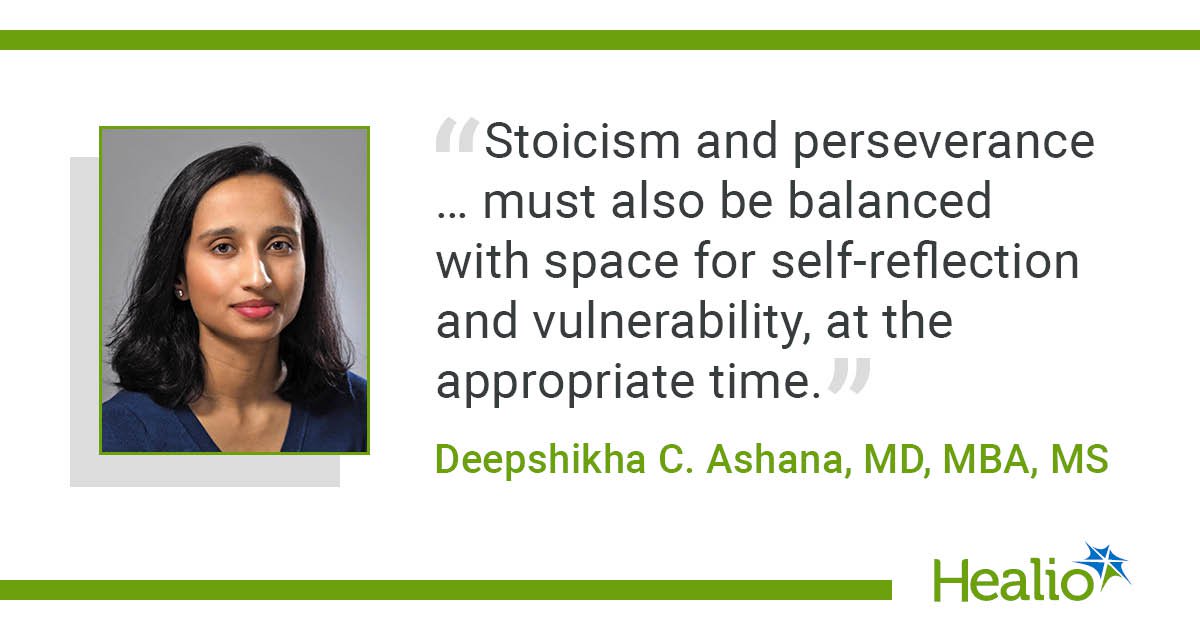
“Many of the findings were notable, but perhaps not surprising because the culture of medicine and critical care is one of stoicism and perseverance,” Ashana told Healio. “These are great qualities in critical situations, and they must also be balanced with space for self-reflection and vulnerability, at the appropriate time.
“I hope that future studies continue to focus on structural solutions to burnout,” Ashana added. “The wellness movement often focuses on actions that individuals can take to support their own mental health, such as therapy or exercise, which are undoubtedly important, but we should expect similar, if not greater, investments from health systems in the health of their workforce.”
For more information:
Deepshikha C. Ashana, MD, MBA, MS, can be reached at deepshikha.ashana@duke.edu.
Perspective

The findings from Ashana and colleagues quantify that many clinicians working in high acuity settings have long experienced traumatic stress as not an occasional byproduct of ICU care but a predictable occupational exposure, and our systems remain inconsistently equipped to address it.
What is most striking is not the prevalence of traumatic stress itself, which is well documented, but the absence of routine normalized practices to recognize and respond to it. In my own experience working in emergency and critical care environments, clinicians are expected to function through repeated exposure to death, moral distress and high stakes decision-making with little formal acknowledgment of the cumulative impact. Support when it exists is often informal, dependent on individual leaders or activated only after a critical incident rather than embedded into everyday practice.
This study highlights an important disconnect between awareness and action. Many of the practices surveyed — such as soliciting feedback, educating clinicians about traumatic stress and helping connect staff to mental health resources — are neither novel nor resource intensive. Yet they remain inconsistently implemented. That suggests the barrier is less about feasibility and more about culture and prioritization. When clinician well-being is treated as optional or secondary, it becomes vulnerable to being deprioritized during periods of high census staffing shortages or operational strain.
Another important takeaway is the role of leadership. The finding that supervisors are often not expected to assess traumatic stress symptoms underscores how ill-prepared many leaders are to identify distress in their teams. Without training and explicit expectations, even well-intentioned supervisors may miss early signs of burnout or trauma allowing problems to escalate.
Future research should move beyond documenting the presence or absence of supportive practices and focus on outcomes. Understanding which interventions meaningfully improve clinician retention, mental health and patient care will be critical. Additionally, frontline clinician perspectives should be incorporated to assess whether reported practices are accessible, trusted and effective in practice.
Ultimately addressing traumatic stress among ICU clinicians requires reframing it as a systems issue rather than an individual failing. Studies like this provide a roadmap for organizations to move from acknowledgment to action, an essential step in sustaining the critical care workforce.
Owais Durrani, DO
Disclosures: Durrani reports no relevant financial disclosures.
Sources/Disclosures
Source:
Ashana DC, et al. Am J Respir Crit Care Med. 2025;doi:10.1164/rccm.202504-0978RL.
Disclosures:
Ashana reports receiving support from the Doris Duke Charitable Foundation; grants/contracts from the NIH/National Heart, Lung, and Blood Institute; and a leadership/fiduciary role in the American Thoracic Society’s ethics and conflict of interest programming committee and the ATS behavioral science and health services research programming committee. Please see the study for all other authors’ relevant financial disclosures.

Ask a clinical question and tap into Healio AI’s knowledge base.
- PubMed, enrolling/recruiting trials, guidelines
- Clinical Guidance, Healio CME, FDA news
- Healio’s exclusive daily news coverage of clinical data