



December 03, 2025
3 min read
Key takeaways:
- Approximately 54% of individuals in the U.S. are affected by a neurological disorder, with headache the most prevalent.
- Stroke, Alzheimer’s disease and related dementias were the leading causes of health loss.
Nervous system disorders impact more than half of the U.S. population, with neurologic and cognitive conditions the leading causes of disability and health loss, according to research published in JAMA Neurology.
“This study highlights that nervous system health for Americans is affected by more than just the conditions that have traditionally been associated with neurological illness,” John P. Ney, MD, MPH, FAAN, assistant professor of neurology at Yale University School of Medicine, told Healio.

Data were derived from Ney JP, et al. JAMA Neurol. 2025;doi:10.1001/jamaneurol.2025.4470.
Prior research has established the connections and relationship between nervous system health and population health, mediated by the direct effect of neurological conditions and other disorders of the nervous system where damage is incurred, Ney and colleagues wrote.
As such, the researchers sought to address a gap in the body of knowledge by quantifying the aggregate of health loss from all nervous system-related disorders including those considered congenital, neonatal and systemic illnesses, as well as infectious diseases, in the United States.
Their cross-sectional study of the Global Burden of Disease 2021 data for nervous system health between 1990 and 2021 yielded 180.3 million individuals (95% UI, 170.7 million to 190.4 million) impacted by nervous system-related disorders in 2021, or 54.2% of the population. Data included analysis of 36 unique nervous system-related conditions that contribute to health loss, specifically 15 neurological conditions linked to mortality.
“While stroke and MS remain incredibly important, there are other important and commonly occurring conditions that have huge effects on the healthy brain, spinal cord, and nerves including diabetes (particularly neuropathy) and neurodevelopmental disorders like autism,” Ney said regarding the wide net the researchers cast for the study data. “Ultimately, patients with all these conditions can benefit clinically from care by a neurologist.”The primary outcome measure was the total number of conditions and age-standardized estimates with 95% uncertainty intervals (UIs) for disability-adjusted life-years (DALYs), years lived with disability (YLDs), years of life lost (YLLs), total attributable deaths and prevalence of the aforementioned conditions by age, sex, location and calendar year.
Nervous system disorders were the top cause of disability, with 16.6 million DALYs (95% UI, 12.9M-20.9M).

John P. Ney
The most prevalent neurological-based conditions were tension-type headache (121.9 million; 95% UI: 109.4M-135.1M); migraine (57.7 million; 95% UI: 50.1M-66.1M); and diabetic neuropathy (17.1 million; 95% UI: 14.4M-19.9M).
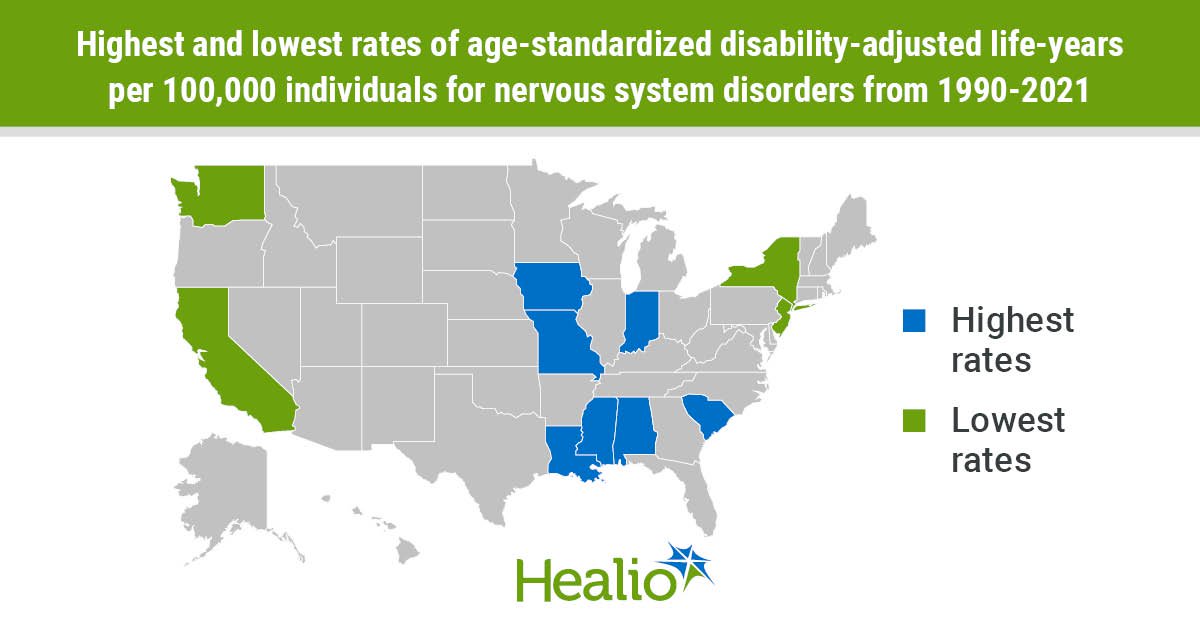
Mississippi, Iowa, Missouri, Alabama, Indiana, Louisiana and South Carolina had the largest age-standardized DALY rates, while New York, California, Washington and New Jersey had the smallest.
The greatest collective disabilities were found with stroke (3.9 million DALYs; 95% UI: 3.5M-4.2M), Alzheimer’s disease and other dementias (3.3 million DALYs; 95% UI: 1.6M-6.9M), diabetic neuropathy (2.2 million DALYs; 95% UI: 1.5M-3M) and migraine (2.1 million DALYs; 95% UI: 0.4M-4.6M).
Compared with age-standardized metrics in 1990, the prevalence of disorders affecting the nervous system was nearly identical (0.2%; 95% UI; 1.5% to 1.9%), with decreased attributable deaths (14.6%; 95%UI: 18.3% to 11.3%) but increased YLDs (9.8%; 95%UI: 4.6-16.6%).
By age, those aged 80 years and older recorded the greatest rates of nervous system health loss (32,928 DALYs), while neurologic health loss for children aged 5 years and younger was 1,739.4 DALYs, greater than that for those aged 5 to 19 years.
Ney and colleagues additionally reported there were twofold to fourfold increases in DALY rates for each subsequent age category (20 to 59 years; 60 to 79 years; and 80 years and older).
Stratified by sex, age-adjusted rates of nervous system–related disorders in 2021 showed a female-to-male ratio (FMR) of 1.1 (95% UI: 1.1-1.2), while DALY rates were nearly identical (FMR = 1; 95% UI: 0.9-1.1). Deaths and YLL rates were greater for men (deaths: FMR = 0.9; 95% UI: 0.9-1; YLLs: FMR = 0.9; 95% UI, 0.8-0.9).“Understanding the enormous impact of these disorders on nervous system health sets the stage for prioritizing funding for scientific research, drug development and implementation of new therapies,” Ney said.
For more information:
John P. Ney, MD, MPH, FAAN, can be reached at neurology@healio.com.

Ask a clinical question and tap into Healio AI’s knowledge base.
- PubMed, enrolling/recruiting trials, guidelines
- Clinical Guidance, Healio CME, FDA news
- Healio’s exclusive daily news coverage of clinical data