




The physical therapy team explains how increased sitting can lead to poor posture and gives some helpful exercises to help prevent this from happening.
Increased Sitting – How to Reduce the Risk of Poor Posture Through Exercise
With school starting up again and kids looking to play more video games after school, it’s time to help prevent poor posture habits.
Studies have shown that while a child sits in his/her chair during class, their posture begins to turn into leaning their trunk, back, hips, and neck into a flexed posture causing musculoskeletal malignment and poor sitting posture.1 This poor posture could lead to changes in the spinal curvature that resembles a kyphotic curvature in the thoracic spine causing the neck to flex and the shoulders to become round as well as a decrease in the natural lordosis that occurs in the lumbar spine.1 The hips can become tilted forward creating an elongation of the lumbar musculature creating low tone and hip instability.1
This blog is to educate parents on how their child should properly be sitting at a desk/table and what exercises they can do to reduce the risk of their child having poor sitting posture.
Appropriate Sitting Posture2
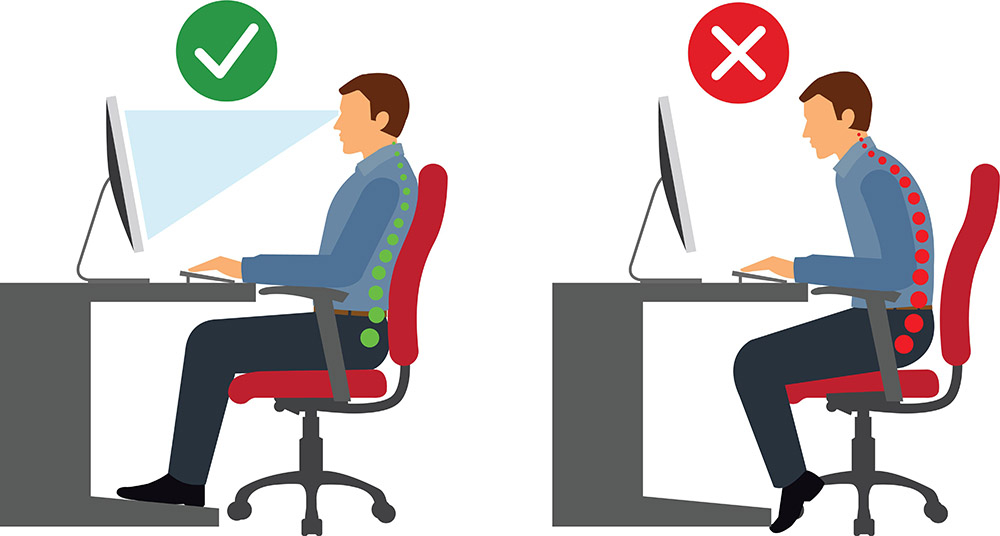
Below is the appropriate technique that should be used when children are sitting at a desk at school or spending long periods in a computer chair playing games.
- 90-90 Rule: Hips, knees, and ankles should be bent at 90 degrees.
- Feet should not be dangling: Add books or a stool under their feet if they do not touch the floor.
- Curved spine: Their spine should be curving forward at the shoulders and top of their back and dipping at their lower back. *as demonstrated in the picture.
- Shoulders should be relaxed when placed on top of the desk/table: Add books/blocks under their bottom to increase their height to allow for the shoulders to stay away from their ears.
Exercises to Perform
Doorway Stretch: Place arms out to the side and gently lean forward till you feel a nice stretch. Perform 10 times holding for 30 seconds.

Shoulder Circles: Create circles using your shoulders going forward and backwards 10 times for 30 seconds.

Shoulder Blade Squeezes: Relax your shoulders and gently squeeze your shoulder blades together. Perform 10 times holding for 3 seconds.
Wall Angels: Place your back against the wall and arms resting at your side. Slide your arms against the wall all the way up like you are making a snow angel. Perform 10 times.
Bird Dogs: Place your hands and knees on the ground. Bring your left arm and right leg up and hold that position. Switch arms and legs. Perform 5 times on each side, holding for 10 seconds each.

Planks: Place either your hands or forearms down and hold the position for 30 seconds, 5 times.
Chin Tucks: Bring your chin down to your chest like you are trying to make a double chin. Perform 10 times and hold for 3 seconds.
Superman: Lay on your belly and bring your hands, thighs, and feet off the floor. Hold for 30 seconds, 5 times.

Bridges: Lay on your back and bring your hips up towards the ceiling. Remember to squeeze your bottom. Hold for 30 seconds, 10 times.
Citations
- Wen L, Lin X, Li C, Zhao Y, Yu Z, Han X. Sagittal imbalance of the spine is associated with poor sitting posture among primary and secondary school students in China: a cross-sectional study. BMC Musculoskeletal Disorders. 2022;23(1). doi:https://doi.org/10.1186/s12891-022-05021-5
- Leis S. Pediatric Physical Therapy For Kids With Poor Posture | Little Feet Therapy | Pediatric Occupational & Physical Therapy Clinic. Little Feet Therapy. Published April 4, 2024. Accessed September 25, 2025. https://littlefeettherapy.com/pediatric-physical-therapy-for-kids-with-poor-posture/