


December 03, 2025
5 min read

Key takeaways:
- Steven Lome, DO, shares his experience with witnessing and assisting two sudden cardiac arrests while running a half-marathon.
- Emergency action planning and defibrillator access have led to improvements in cardiac arrest outcomes in recent years.
The popularity of long-distance running races continues to grow. With rising public enthusiasm for endurance exercise comes interest among health care professionals in its health and cardiovascular implications.
Over the last 2 decades, the number of recreational athletes participating in marathons and half-marathons increased threefold. More than 29 million people completed marathons and half marathons from 2010 to 2013 compared with about 11 million people in 2000 to 2009, according to data from the Race Associated Cardiac Event Registry (RACER).

Data published in JAMA this year from the RACER 2 trial highlighted a stable incidence of sudden cardiac arrest during long-distance running races over the past 2 decades, while the risk for sudden cardiac death markedly declined. Researchers said this is likely due to continued enhancements in emergency action plan preparedness, with immediate automated external defibrillator access, deployment and placement on racecourses, leading to early defibrillation.
Healio spoke with Steven Lome, DO, who had a unique experience when he ran the Monterey Bay Half Marathon in 2022. While running the race, Lome witnessed and subsequently assisted with two sudden cardiac arrest incidents. Thanks to the efforts of Lome, who is the cardiology medical director at Montage Medical Group in Monterey County, California and lifestyle medicine physician at the Community Hospital of the Monterey Peninsula, and others on scene, both of those runners made a full recovery.
Though Lome described this experience that day as “a statistical anomaly,” he said it underscores the importance of emergency preparedness and increased awareness.
Healio: Tell us about your experience during the half-marathon?
Lome: At mile three of the Monterey Bay Half Marathon in November 2022, a runner collapsed, right in front of me. As I approached and assessed, it was clear he was pulseless and in cardiac arrest. I started CPR, and some other runners stopped to help. We called 911 and I continued CPR, although it took about 5 to 6 minutes before a defibrillator arrived. The rhythm was ventricular fibrillation, which is universally fatal unless you defibrillate the patient. We were able to successfully restore normal rhythm, and he regained consciousness and went to the hospital by ambulance. I called the emergency room to inform them of what happened.
I continued the race, which I was running with my two older kids. They were far in front of me at this point, thinking Dad was just slow. I crossed the finish line almost 2 hours later, when another runner, a 50-year-old man, collapsed right in front of me. He also had no pulse and wasn’t breathing, so I started CPR on him immediately. Fortunately for the second man, there was a medical tent at the finish line so a defibrillator arrived within a couple minutes. We were able to successfully defibrillate him fast — so fast, in fact, that he woke up and thought he had simply fainted.
Both of these men had coronary artery disease, with stable blockages. They weren’t actively clotted like a big heart attack, but they both received stents to restore blood flow.
Both made a complete recovery.
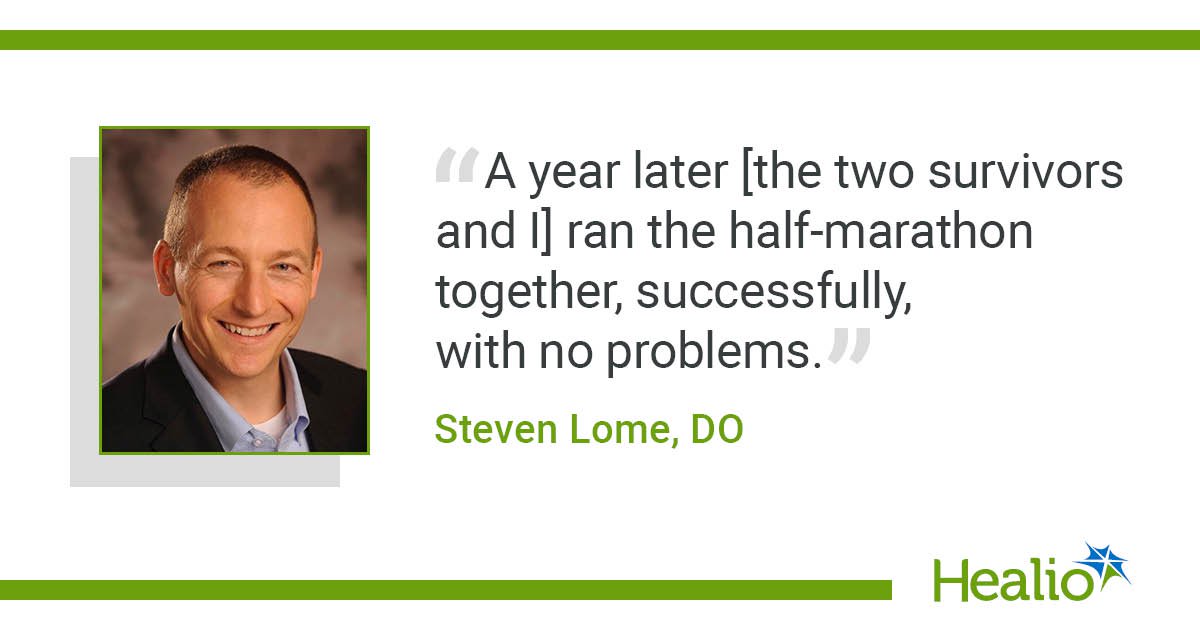
A year later, the three of us ran the half-marathon together, successfully, with no problems.
Having two cardiac arrests in the same race of that size was a statistical anomaly. There were only about 5,000 race participants; one might expect one cardiac arrest in that race every 20 years or so, based on the numbers that have been published. But we had two of them in the same year, in the same race, which is very unlikely. And what are the odds of a cardiologist running right behind both of them when it happened?
Healio: With the growing participation in marathons and half-marathons around the world, what should people know about awareness of sudden cardiac events?
Lome: Awareness is so important. The unfortunate truth is that the first symptom in some cases is the sudden cardiac arrest. There are not always warning signs that something is wrong.
However, in a large percentage of these cases, the problem that results in the cardiac arrest can usually be detected in advance and treated so that death can be prevented. It is vital to identify these patients and treat them appropriately. Cardiac arrest is preventable, and screening can catch a lot of it.
Healio: Recent data have shown that rates of sudden cardiac arrest during long-distance running races have remained relatively stable and rates of sudden cardiac death declined over the past 2 decades. What do you make of this?
Lome: In the RACER 2 trial, cardiac arrest survival rates among 29 million participants of U.S. marathons and half-marathons were dramatically improved from 2010 to 2023 compared with prior decades. Editor’s note: Click here to read more about results from the RACER 2 trial.
I agree with the authors’ conclusion that this is likely due to better race preparedness, more accessibility to defibrillators and more people knowing how to do CPR. We see defibrillators all over the place now, and they have become simpler to use, creating a higher comfort level for people who need to use them.
While the overall incidence of sudden cardiac arrest was relatively unchanged over 2 decades, incidence increased slightly since 2020. The reasons for this increase after 2020 are unknown. But the researchers theorized that during the COVID-19 pandemic, many people avoided health care services, and because they were not seeing their doctor and getting regular checkups, fewer disease processes were caught, possibly resulting in a higher risk for cardiac arrest. The two runners who I resuscitated after their cardiac arrests had coronary artery disease, which was the most common cause of cardiac arrest cases in RACER 2. Neither runner had myocarditis or pericarditis or any inflammation from COVID-19 or active infection.
Healio: What lessons can be learned from these data and your experience?
Lome: Since this happened, I, along with Greg and Mike — the two survivors I assisted during the 2022 half-marathon — have spoken at a number of charity events and fundraisers about this experience. We try to emphasize three important points. No. 1: Everybody should learn CPR. No. 2: People should get their heart checked, especially if they have risk factors for heart disease, or if they’re going to do intense activities like running a full marathon. And, No. 3, it’s important to emphasize that exercise is great for heart health. Don’t think that because of this story, you shouldn’t exercise. Experts generally say about 80% of coronary risk relates to dietary habits, and 20% or less relates to physical activity and exercise. So, it’s great to exercise, but if you’re not focusing on diet too, then you’re missing the boat and could have a major health issue like developing coronary artery disease or having a sudden cardiac arrest like Greg and Mike both did.
For more information:
Steven Lome, DO, is founder of Healio’s Learn the Heart. He can be reached at cardiology@healio.com.
Sources/Disclosures
Source:
Healio Interviews
Reference:
Disclosures:
Lome reports no relevant financial disclosures.

Ask a clinical question and tap into Healio AI’s knowledge base.
- PubMed, enrolling/recruiting trials, guidelines
- Clinical Guidance, Healio CME, FDA news
- Healio’s exclusive daily news coverage of clinical data