




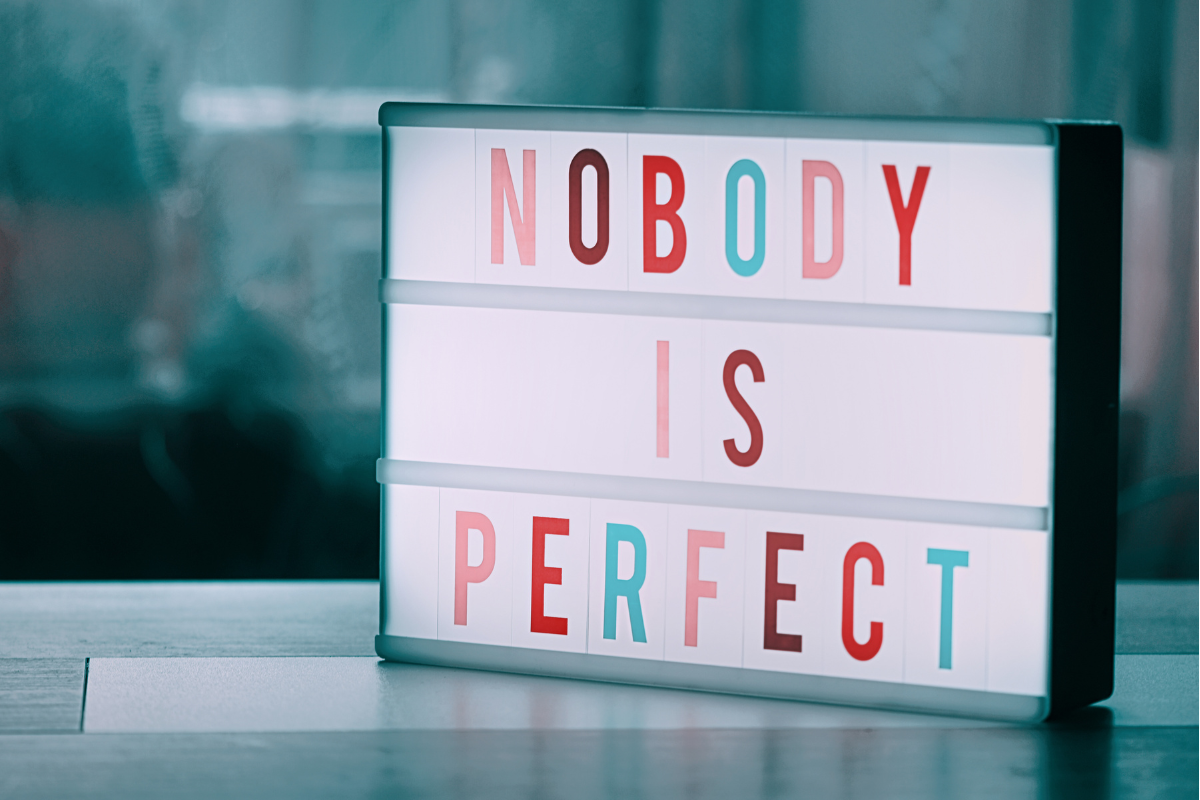
One question I ask all my new clients is, “Do you believe you have to eat perfectly to be a healthy eater?” Often, but not always, the answer is “Yes.”
That’s one “flavor” of “If I’m not perfect, I’m a failure.” I’ve also watched people struggle with a similar mindset about exercise, and about practicing new behaviors and building new habits, such as:
- Meditation and mindfulness
- Tuning into hunger and fullness cues
- Reading a recommended article or blog post
- Food journaling
- Identifying emotions
The BIG problem with all of this is that when you strive for and expect perfection, failure is a given. You can only stretch a rubber band so far before it snaps.
A “perfect” diet or a “perfect” exercise plan (perfect in construction and execution) doesn’t guarantee perfect health (or weight loss). Being “perfect” about meditating, checking in with hunger/fullness, getting to bed on time, and other good things doesn’t guarantee a specific outcome on a specific timeframe. Life is a journey, and there’s no finish line (well, until we die, that is).
“Perfect” is an illusion, because it’s subjective. What really matters is progress, and for that it’s OK to aim for “good enough.”

A vicious cycle
Fear of failure, especially if you feel a lot of shame around “failing” can feed the drive to be perfect in order to avoid the discomfort of shame. But to err (aka to fail) is human), so your eventual and inevitable failures can further feed perfectionism.
On the surface, trying to eat perfectly, exercise perfectly, practice intuitive eating perfectly, may seem like a good way to fast track your goals. But look deeper, and striving for perfect can make your life smaller, and quite rigid.
Trying to be a “perfect’ eater makes it difficult if not impossible to share meals with others. You can’t comfortably accept a dinner party invitation if your hosts don’t share your food rules. You can’t meet up at a restaurant unless you’re the one micromanaging which restaurant and obsessing ahead of time about what’s “safe” to order. If you forget your packed lunch at home, buying your lunch may be so anxiety producing that you just don’t eat at all.
Trying to be a “perfect” exerciser means saying “No” to plans with friends or family if they interfere with a planned workout. It may mean shorting yourself on sleep if life events kept you up late and you have to choose between sleeping in or exercising. It means not letting yourself change the type of movement you do if you realize your “perfect” fitness plan has become tedious. It may mean pushing through an injury, possibly doing more long-term harm.
Trying to be a “perfect” intuitive eater basically means never becoming an intuitive eater, because rigidity and inflexibility is the antithesis of the spirit of intuitive eating. (I can say the same thing about trying to practice mindfulness “perfectly.”)

The perfection of imperfection
Most people I know who skew perfectionistic tell me of times when they did follow this diet or that workout plan “perfectly,”and if they could only manage to do it again than everything would be OK.
But a “perfect” plan that you can’t maintain for the long haul despite your best intentions and efforts is actually imperfect. And, again, trying to be perfect is like stretching a rubber band. Eventually, it’s going to snap.
A “perfect” eating or exercise plan is only perfect if it allows for flexibility and change over time. If it allows for job changes and health changes and life changes. If it works when you’re busy and when you’re not. If it allows for eating alone, eating with family, eating with friends, eating while traveling…without anxiety. It allows you to not feel like you should be hitting the gym instead of waking on the beach or going sightseeing when you’re on vacation.
A ”perfect” plan allows you to see when it’s…not perfect. When it requires more time/money/energy than you have, when it’s not enjoyable enough of the time, when it’s not making you feel good or make progress towards individual health and well-being goals.
And that’s where that flexibility comes into play again.
Something I often tell my clients is that there are no mistakes, there’s just information. When you make what feels like a mistake — or a fail — that’s valuable information. Why did you “fail”? Were you trying to hold yourself to impossible standards? Were other aspects of your plan not quite right for you?

The power of flexibility
When a “perfect” plan is working, it allows you to be flexible and spontaneous before snapping back like a stretchy — not snapped — rubber band. Because you’re not being rigid, when you take a day off from exercise or accept an impromptu dinner invitation, you don’t feel like you failed. Because you don’t feel like you failed, you don’t feel shame. Because you don’t feel shame, you don’t start an ugly downward spiral.
If you eat food that leaves you not feeling physically well, you note it, thank your body for that information, and move on.
If you have a wicked work week coming up and realize you’ll need to rely more heavily on takeout or convenience foods that you do usually, you can simply make the best choices that work under the circumstances — then easily return to your plan when conditions improve.
This involves a lot of mindset shifting. When deviating from a plan leads to shame (shame is the belief that you are a bad human, that you aren’t worthy), that needs some investigation and excavation.
People who know their worth, know their value, and recognize that all humans are perfectly imperfect and make mistakes are more likely to form habits that feel good, not punishing. They’re also able to hit “pause” when needed without getting in the headspace that because they “messed up” there’s no point in trying.
Basically, flexibility spares you the type of all-or-nothing thinking that can send you swinging back and forth from the “perfect” diet to the “f*ck-it diet.” It lets you settle into that happy medium that’s good for both physical and mental health.
Need more help getting off the perfectionism hamster wheel and improving your relationship with food, eating and body image? Click here to schedule a free 20-minute Discovery Call to talk about your concerns, and if you would benefit from nutrition therapy.
Related posts:

Disclaimer: All information provided here is of a general nature and is furnished only for educational purposes. This information is not to be taken as medical or other health advice pertaining to an individual’s specific health or medical condition. You agree that the use of this information is at your own risk.
Hi, I’m Carrie Dennett, MPH, RDN, a weight-inclusive registered dietitian, nutrition therapist and body image counselor. I help adults of all ages, shapes, sizes and genders who want to break free from eating disorders, disordered eating or chronic dieting. If you need to learn how to manage IBS symptoms with food, or improve your nutrition and lifestyle habits to help manage a current health concern or simply support your overall health and well-being, I help people with that, too.
Need 1-on-1 help for your nutrition, eating, or body image concerns? Schedule a free 20-minute Discovery Call to talk about how I can help you and explore if we’re a good fit! I’m in-network with Regence BCBS, FirstChoice Health and Providence Health Plan, and can bill Blue Cross and/or Blue Shield insurances in many states. If I don’t take your insurance, I can help you seek reimbursement on your own. To learn more, explore my insurance and services areas page.
Want exclusive content on nutrition, health, diet culture and more, plus critiques of nutrition and health journalism? Subscribe to my Food Noise newsletter! 📣