


[ad_1]
November 09, 2025
3 min read
Key takeaways:
- Following breast reconstruction, the risk for revision surgery was greater among those with vs. without atopic skin conditions.
- After bone grafting, this risk was also raised in those with atopic disease.
ORLANDO — Adults with vs. without atopic disease had higher risks for difficulties after breast reconstruction and bone grafting, according to data presented at the American College of Allergy, Asthma & Immunology Annual Scientific Meeting.

Joshua Wang
“These results suggest that clinicians should keep a patient’s atopic history in mind when planning and following up after bone grafting,” Joshua Wang, MS, lead author of the study on bone grafting and medical student at the University of Texas Medical Branch John Sealy School of Medicine, told Healio. “Being aware of that added risk can help guide counseling, closer monitoring and potentially earlier intervention if complications arise.”

Data were derived from Wang J, et al. Atopic disease is associated with increased complications following bone grafting: A multicenter retrospective cohort study. Presented at: ACAAI Annual Scientific Meeting; Nov. 6-10, 2025; Orlando.

Philong Nguyen
Philong Nguyen, BS, lead author of the study on breast reconstruction and medical student at the University of Texas Medical Branch John Sealy School of Medicine, added that “recognizing atopic disease as a potential risk factor and effectively communicating this to patients remains essential.”
Breast reconstruction
In the first study, Nguyen and colleagues assessed women breast cancer patients who underwent implant-based reconstruction between 2002 and 2022 to uncover how the risk for implant-related complications after surgery differs among those with vs. without prior diagnoses of eczema, dermatitis or other allergic skin conditions.
Researchers used propensity scores to match the groups with each other based on demographics, comorbidities, autoimmune diseases and treatment exposures including radiation, chemotherapy, hormone therapy and steroids. This yielded 10,205 women in each group.
Compared with women without atopic conditions, the risk for implant complications after reconstruction was significantly raised among women with atopic conditions (RR = 1.2; P < .0001), according to the analysis.
At the 1-year, 2-year and 3-year marks following surgery, the risk for revision surgery was significantly greater among those with vs. without atopic conditions (RR = 1.1; P < .001), as was the risk for implant removal (RR = 1.2; P .004) and implant infection (RR = 1.2; P .0009).
The risk for capsular contracture was also significantly heightened in the group with vs. without atopic conditions, but this was found at the 2-year and 3-year marks (RR = 1.2; P .0005). Similarly, researchers reported that women with vs. without atopic conditions had a significantly raised risk for implant rupture at these two time points (RR = 1.4; P .0457).
“Our topic should ideally be further evaluated through prospective cohort studies to establish causation,” Nguyen told Healio. “While our current work leverages a large national database with an extensive sample size, it can only demonstrate associations, not causal relationships.
“Ultimately, our study helps lay the groundwork for future research to explore these causal links more directly,” he added.
Bone grafting
In a different study, Wang and colleagues assessed adults who underwent bone grafting procedures between 2017 and 2023 via the TriNetX research network to determine how the risk for complications after surgery differs among those with vs. without atopic diseases (asthma, atopic dermatitis and allergic rhinitis).
Similar to the breast reconstruction study, researchers used propensity scores to match the groups with each other based on demographics (age, sex, race and BMI) and comorbidities (hypertension, diabetes mellitus, coronary artery disease, chronic kidney disease, COPD and smoking), and this resulted in 19,334 patients in each group.
The risk for infection/wound complications was significantly elevated among those with vs. without atopic disease when evaluated at 90 days after the bone grafting procedure (HR = 1.19; 95% CI, 1.08-1.32). This pattern was also true for the risk for osteomyelitis (HR = 1.29; 95% CI, 1.12-1.48) and the risk for hardware removal (HR = 1.22; 95% CI, 1.05-1.41) at this timepoint, according to the study.
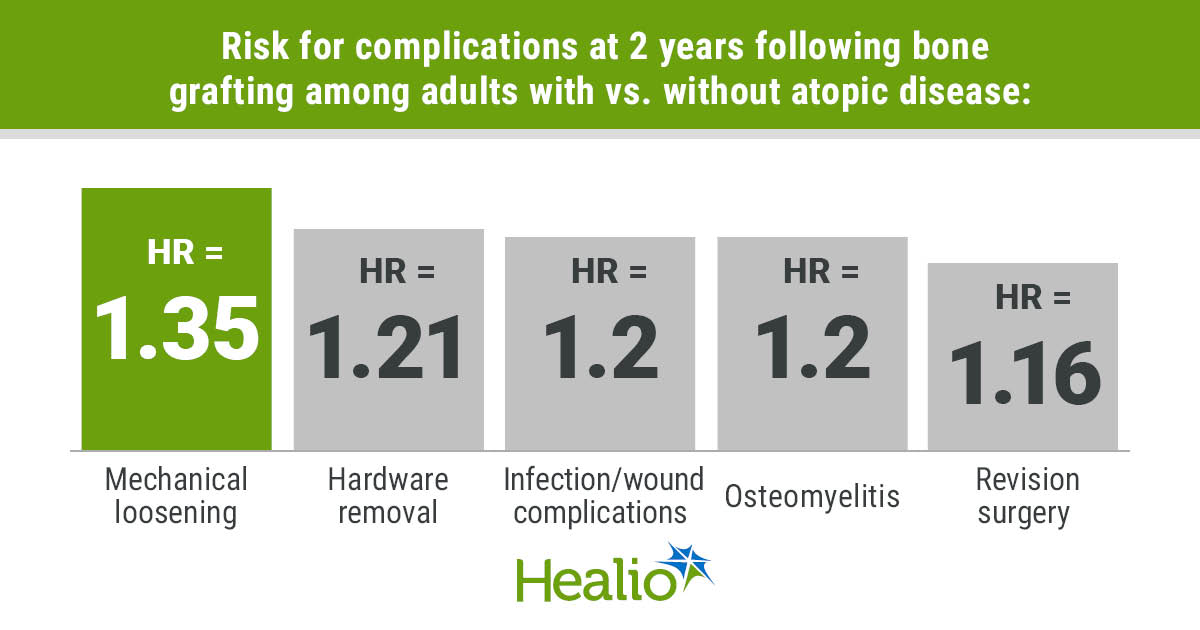
Notably, researchers found that each of the above risks continued to be significantly heightened in the group with vs. without atopic disease at the 2-year mark following surgery: infection/wound complications (HR = 1.2; 95% CI, 1.11-1.31), osteomyelitis (HR = 1.2; 95% CI, 1.08-1.33) and hardware removal (HR = 1.21; 95% CI, 1.11-1.33).
Other risks that were significantly raised among those with vs. without atopic disease at this time point included mechanical loosening (HR = 1.35; 95% CI, 1.17-1.56) and revision surgery (HR = 1.16; 95% CI, 1.09-1.25).
“We were surprised by the consistency of the increased risk for osteomyelitis and hardware removal among patients with atopic disease,” Wang told Healio. “While we expected some association between atopy and mechanical complications, seeing these specific risks persist across both short- and long-term follow-up was unexpected.”
The study further reported that the risk for graft failure, pathological fractures, debridement and opioid abuse in the atopic disease group did not significantly differ from the group without atopic disease at 90 days or 2 years.
“In the future, we hope to explore this further by looking at the management of atopic conditions and whether optimizing disease control can help mitigate some of the risks we observed in our study,” Wang said.
For more information:
Philong Nguyen, BS, can be reached at longnguy@utmb.edu.
Joshua Wang, MS, can be reached at joswang@utmb.edu.
Sources/Disclosures
Source:
Nguyen P, et al. Association between atopic skin disease and implant-related complications in breast reconstruction. Presented at: ACAAI Annual Scientific Meeting; Nov. 6-10, 2025; Orlando.
References:
- People with allergies or eczema may face higher risk of surgical complications. https://annualmeeting.acaai.org/2025/surgical-complications.cfm. Published Nov. 6, 2025. Accessed Nov. 6, 2025.
- Wang J, et al. Atopic disease is associated with increased complications following bone grafting: A multicenter retrospective cohort study. Presented at: ACAAI Annual Scientific Meeting; Nov. 6-10, 2025; Orlando.
Disclosures:
Nguyen and Wang report no relevant financial disclosures.

Ask a clinical question and tap into Healio AI’s knowledge base.
- PubMed, enrolling/recruiting trials, guidelines
- Clinical Guidance, Healio CME, FDA news
- Healio’s exclusive daily news coverage of clinical data
[ad_2]
Source link