




[ad_1]
November 10, 2025
5 min read

Key takeaways:
- The Pan American Health Organization did not reverify the Americas as measles-free.
- The decision was based on Canada having a measles outbreak lasting longer than a year.
A commission in charge of monitoring efforts to eliminate measles from the Americas has decided that the region can no longer be considered free of the highly contagious disease.
The decision not to reverify the entire region as being measles-free was based on a large outbreak in Canada that began last October, the Pan American Health Organization (PAHO) said Monday.

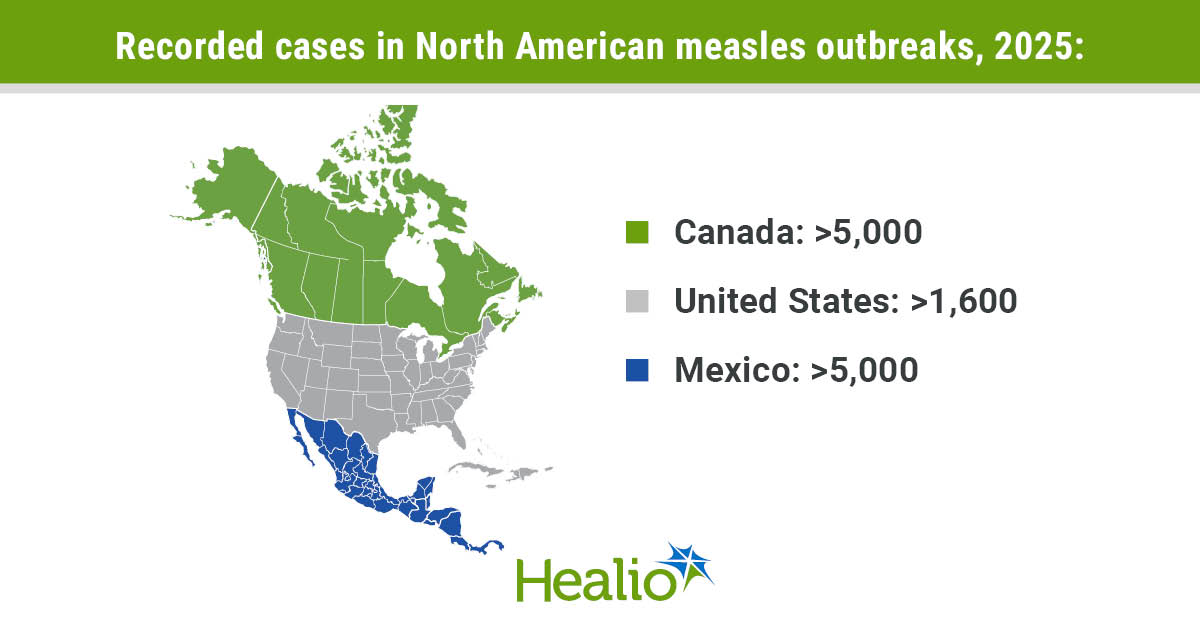
Data derived from PAHO.
One of the ways a country — and region — can lose its measles elimination status is by having an outbreak that lasts more than 1 year. At that point, the country is considered to have endemic measles again.
The United States is also close to the 1-year anniversary of a spate of measles outbreaks that started with an outbreak in West Texas on Jan. 20, according to PAHO. If new cases traced to that outbreak continue to be recorded beyond the 1-year anniversary of that date, the U.S. will risk losing the country-level measles-free status it achieved in 2000, PAHO said. (The last time the U.S. got this close was in 2019 when a large outbreak in New York City lasted around 11 months.)
North and South America — including nations in the Caribbean and Central America — are grouped together as one of six WHO-designated regions. An independent body of experts called the Measles and Rubella Elimination Regional Monitoring and Re-Verification Commission is in charge of reviewing the region’s progress against the two diseases and making recommendations to the PAHO director on reverification.
That commission met for 4 days last week in Mexico City and recommended to PAHO director Jarbas Barbosa, MD, PhD, that the region lose its measles-free status based on the Canadian outbreak.
“Canada was unable to stop endemic transmission. When one country loses that status, the whole region loses it,” Barbosa said during a press briefing Monday.
‘Canary in the coal mine’
Among diseases that have largely been controlled by vaccines, measles is seen as a “canary in the coal mine” — an early warning that outbreaks of other vaccine-preventable diseases may be possible as vaccine coverage erodes. This is because measles is among the most contagious diseases in the world, capable of surviving in a room for as long as 2 hours after a person with the virus has left. One sick person can be expected to infect 18 others, Barbosa said.
The Americas became the first WHO region ever declared free of measles in 2016 after going 14 years without a locally acquired case. The region lost that status within a few years because of long outbreaks in Venezuela and Brazil but regained it last year.
Multiple new outbreaks of measles have popped up in North America since then, including large outbreaks in Canada and Mexico that involve more than 5,000 cases each and dozens of outbreaks spread across most of the U.S.
Canada has recorded more than 5,100 confirmed or probable cases of measles this year in multiple provinces, including two infant deaths from congenital measles. The cases are linked to an outbreak that began in New Brunswick in October 2024.
This is the first time Canada is considered to have endemic measles since the country achieved elimination status in 1998.
“This loss represents a setback, but it’s also reversible,” Barbosa said. “This is not the first time we have faced this situation. Today, we have better experience and tools.”
A country can regain its status by interrupting transmission of the virus for more than 12 months, which is usually accomplished by increasing vaccination rates and improving measles surveillance.
“The measles vaccine is the best way to protect you and your family,” the Public Health Agency of Canada said in a statement. “By staying vigilant and working together to increase measles vaccine coverage, we can prevent outbreaks and keep our communities safe against this preventable disease.”
Declining vaccination rates
Measles cases in the U.S. this year hit a level not seen since 1992, driven by the larger outbreak in West Texas, which began in Gaines County and spread rapidly through areas of low MMR vaccine coverage. One school district in the county reported an MMR coverage rate of just 46%.
Vaccine rates are trending down nationally, too. Kindergarten vaccination coverage for measles and other infectious diseases declined again during the 2024-2025 school year, according to CDC data published this past summer, which showed the rate of MMR vaccine coverage was just 92.5% — well below the 95% coverage widely said to be necessary to prevent outbreaks. Twenty states reported coverage below 91%.
Despite declining measles vaccination rates, CDC vaccine advisors appointed by HHS Secretary Robert F. Kennedy Jr. voted recently to revoke federal support for one of several measles vaccine options for young children — a shot that combines protection against measles, mumps, rubella and varicella, which around 5% of young children receive.
Overall, there have been 1,681 confirmed measles cases in 44 outbreaks in 41 U.S. states this year, according to the CDC. That’s an increase of 56 cases since last Monday. Among all the cases, 92% occurred in people who were unvaccinated or whose vaccine status was unknown.
More than 1 in 10 people with measles in the U.S. this year had to be hospitalized, and three people have died — the country’s first measles deaths in a decade.
Although the outbreak that started in Texas was declared over in August, Daniel Salas, executive manager of PAHO’s special program on comprehensive immunization, noted that new cases continue to be reported from other states, including Arizona, Utah and South Carolina.
Salas indicated that the U.S. will be in jeopardy of losing its measles-free status if it cannot definitively show that there is no clear link between new cases and the Texas outbreak that started last January.
“Of course, we are hoping that the U.S. is going to stop transmission before that deadline,” Salas said during the press briefing.
Mexico is also in the midst of a large measles outbreak that began in February and now includes more than 5,000 cases, according to PAHO.
As of Sept. 19, the three North American countries had accounted for 96% of all measles cases in the Americas this year, dwarfing smaller outbreaks in several South American countries, according to PAHO, which cited vaccine hesitancy and limited access to vaccines in vulnerable communities as “significant barriers” to measles control.
Sources/Disclosures
Source:
Press Conference
References:
- CDC. Measles cases and outbreaks. https://www.cdc.gov/measles/data-research/index.html. Updated Nov. 5, 2025. Accessed Nov. 10, 2025.
- Fourth annual meeting of the Measles and Rubella Elimination Regional Monitoring and Re-Verification Commission. 4–6 November 2024 (virtual). https://www.paho.org/en/documents/fourth-annual-meeting-measles-and-rubella-elimination-regional-monitoring-and-re. Updated Dec. 18, 2024. Accessed Nov. 10, 2025.
- Government of Canada. Measles and rubella weekly monitoring report. https://health-infobase.canada.ca/measles-rubella/. Last updated Nov. 3, 2025. Accessed Nov. 10, 2025.
- Measles cases rose globally, while the Americas Region regains measles elimination status. https://www.paho.org/en/news/14-11-2024-measles-cases-rise-globally-while-americas-region-regains-measles-elimination. Published Nov. 14, 2024. Accessed Nov. 10, 2025.
- PAHO intensifies call to strengthen vaccination in light of rising measles cases in the Americas. https://www.paho.org/en/news/19-9-2025-paho-intensifies-call-strengthen-vaccination-light-rising-measles-cases-americas. Published Sept. 19, 2025. Accessed Nov. 10, 2025.
- Statement from the Public Health Agency of Canada on Canada’s measles elimination status. https://www.canada.ca/en/public-health/news/2025/11/statement-from-the-public-health-agency-of-canada-on-canadas-measles-elimination-status.html. Published Nov. 10, 2025. Accessed Nov. 10, 2025.
- Texas announces end of West Texas measles outbreak. https://www.dshs.texas.gov/news-alerts/texas-announces-end-west-texas-measles-outbreak. Published Aug. 18, 2025. Accessed Nov. 10, 2025.
Disclosures:
No products or companies that would require financial disclosure are mentioned in this article.

Ask a clinical question and tap into Healio AI’s knowledge base.
- PubMed, enrolling/recruiting trials, guidelines
- Clinical Guidance, Healio CME, FDA news
- Healio’s exclusive daily news coverage of clinical data
[ad_2]
Source link