


[ad_1]
December 31, 2025
2 min read

Key takeaways:
- Visual acuity and motor coordination significantly improved after 6 months of using AmblyoPlay.
- The treatment provides benefits beyond visual acuity.
Children with amblyopia who used the AmblyoPlay app 5 days a week for 6 months had significant improvements in visual acuity, as well as oculomotor function and motor coordination, according to data published in BMC Ophthalmology.
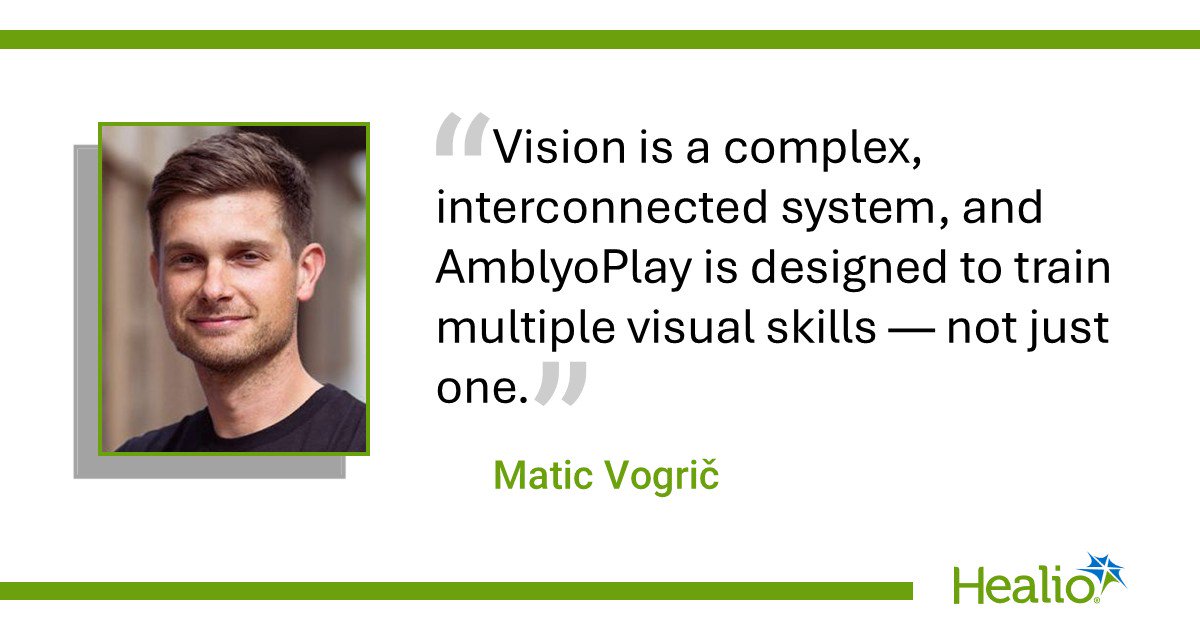
“These findings reinforce our core belief that amblyopia treatment must go beyond visual acuity,” Matic Vogri, CEO of Smart Optometry, the maker of AmblyoPlay, told Healio. “Vision is a complex, interconnected system, and AmblyoPlay is designed to train multiple visual skills — not just one.”

AmblyoPlay is an app intended to treat amblyopia through dichoptic therapy, where children with amblyopia can play games while wearing red-green anaglyph glasses. The app and glasses are commercially available but not cleared by the FDA for treatment of amblyopia.
The pilot study was conducted by Yua Basoglu and colleagues from Medipol University, in Istanbul. It included 29 children aged 7 to 13 years, 14 of whom had anisometropic amblyopia and 15 of whom were age- and sex-matched children with normal ocular health, who served as a control group.
The app was used at home for 30 minutes, 5 days per week, for 6 months, with compliance tracked through a cloud-based system.
The researchers assessed visual acuity via logMAR; stereopsis via Titmus Fly Test; oculomotor parameters via saccadic latency, smooth pursuit gain and optokinetic gain; motor proficiency via subtests of the Bruininks-Oseretsky Test of Motor Proficiency, Second Edition (BOT-2); and postural stability via the Sensory Organization Test.
At baseline, the children with amblyopia had an average logMAR visual acuity of 0.23. After using AmblyoPlay, that decreased to 0.14 at 1 month, 0.12 at 3 months and 0.08 at 6 months (P < .001). Stereopsis also improved from a baseline median of 300 arcsec to a median of 45 arcsec at 6 months (P < .001).
The AmblyoPlay group saw benefits for oculomotor function, with significant improvements in saccadic latency, smooth pursuit gain and optokinetic responses (P < .05 for all). There were significant improvements in the balance (P < .001) and upper extremity coordination (P = .001) subtests of BOT-2, the latter of which was a measure of hand-eye coordination. Improvement in postural function did not reach statistical significance.
The control group had no significant changes in any of these outcomes.
“The study’s improvements in oculomotor function and motor coordination highlight a major differentiator of our platform: We approach amblyopia as a binocular condition that requires restoring teamwork between the eyes,” Vogri said. “By activating broader visual pathways, we achieve benefits that extend well beyond acuity. This validates our system-level approach and clearly sets AmblyoPlay apart from traditional therapies.”

Ask a clinical question and tap into Healio AI’s knowledge base.
- PubMed, enrolling/recruiting trials, guidelines
- Clinical Guidance, Healio CME, FDA news
- Healio’s exclusive daily news coverage of clinical data
[ad_2]
Source link