



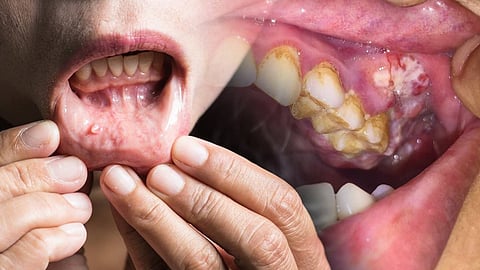

More than six out of 10 people in India are suffering from mouth (buccal
mucosa) cancer due to frequent consumption of alcohol, with locally
brewed drinks associated with the greatest risk, along with chewing of
smokeless tobacco products such as gutkha, khaini, paan, according to a
large study published on Wednesday.
The study, authored by a team of researchers from the Center for
Cancer Epidemiology, and Homi Bhabha National Institute, in Maharashtra,
showed that as little as under 2 g a day of beer was associated with a
heightened risk of buccal mucosa cancer, while 9 g a day of alcohol —
equivalent to around one standard drink — was associated with an
approximately 50 percent increased risk of mouth cancer.
When combined with chewing tobacco, it likely accounted for 62 percent of all such cases in the country.
The
findings, detailed in the open-access journal BMJ Global Health,
suggest that more than one in 10 cases (nearly 11.5 percent) of all
buccal mucosa cancers in India are attributable to alcohol, rising to 14
per cent in some of the states with a high prevalence of the disease,
such as Meghalaya, Assam, and Madhya Pradesh.
“Alcohol was a
contributory factor to the heightened risk of mouth cancer, irrespective
of how long tobacco had been used. Ethanol might alter the fat content
of the inner lining of the mouth, increasing its permeability and
therefore its susceptibility to other potential carcinogens in chewing
tobacco products,” explained the research team led by Grace Sarah
George.
Possible contamination with toxins, such as methanol and
acetaldehyde, in locally brewed alcohol, might help explain the higher
risk associated with these drinks, the manufacture of which is largely
unregulated,” they said.
Mouth cancer is the second most common
malignancy in India, with an estimated 143,759 new cases and 79,979
deaths every year. Rates of the disease have risen steadily, and now
stand at just under 15 for every 100,000 Indian men, noted the
researchers.
The primary form of mouth cancer in
India is that of the soft pink lining of the cheeks and lips (buccal
mucosa). Less than half (43 per cent) of those affected survive five or
more years.
In the study, the researchers compared 1,803 people
with confirmed buccal mucosa cancer and 1,903 randomly selected people
free of the disease (controls) from five different study centres between
2010 and 2021. Most of the participants were aged between 35 and 54;
nearly half (around 46 per cent) of cases were among 25-to 45-year-olds.
Compared
with those who didn’t drink alcohol, the risk was 68 per cent higher
for those who did, rising to 72 per cent for those favouring
internationally recognised alcohol types such as beer, whiskey, vodka,
rum, and breezers (flavoured alcoholic drinks), and to 87 per cent for
those opting for locally brewed drinks like apong, bangla, chulli, desi
daru, and mahua.
“Our study demonstrates that there is no safe limit of alcohol
consumption for [buccal mucosa cancer] risks. Our findings suggest that
public health action towards prevention of alcohol and tobacco use could
largely eliminate [buccal mucosa cancer] from India,” the team said.