


December 03, 2025
2 min read

Key takeaways:
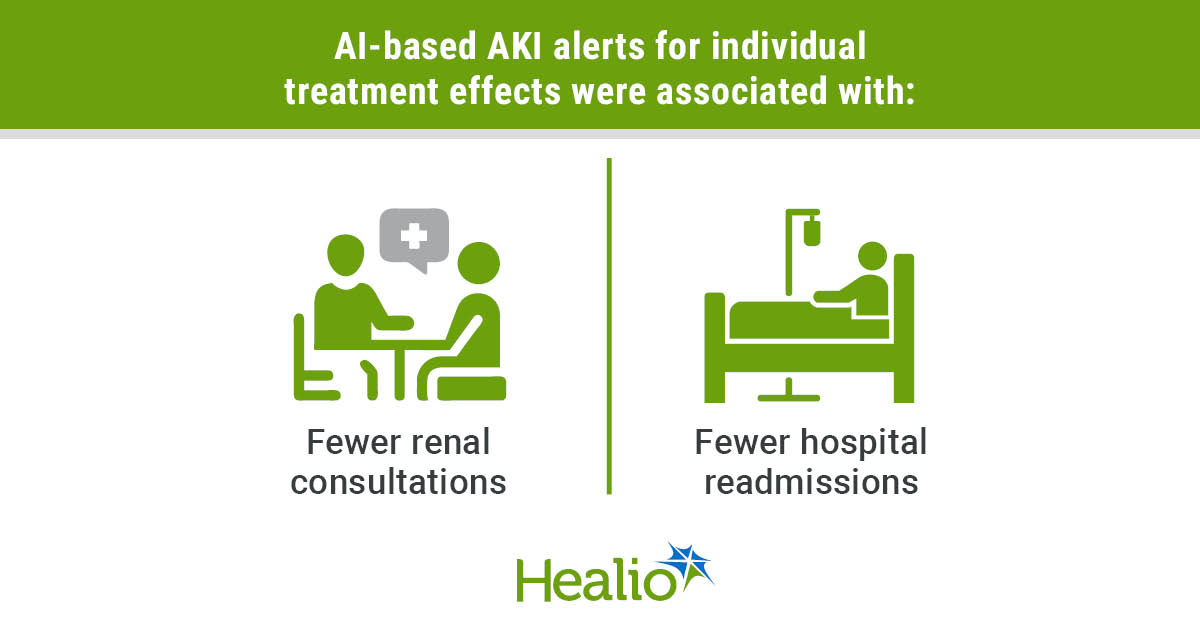
- Lower readmission rates and fewer renal consultations were reported for patients with a targeted AKI alert.
- However, alerts did not significantly affect AKI progression or dialysis or mortality rates.
HOUSTON — An individual treatment effect model did not improve clinical outcomes for patients with AKI, but it could improve clinician responses to AKI alerts, according to data presented at ASN Kidney Week.
Researchers at Yale previously conducted the ELAIA-1 trial, which found AKI alerts did not improve clinical outcomes for patients, according to Laura Aponte Becerra, MD, a nephrology fellow at Yale School of Medicine. However, the researchers found the patient population was highly heterogeneous.

Data derived from Aponte Becerra L, et al. FR-OR084. Presented at: ASN Kidney Week; Nov. 5-9, 2025; Houston.
Continuing from these findings, Aponte Becerra and colleagues explored whether an individual treatment effect model, an AI-based approach traditionally used in marketing to identify potential customers, could be applied to the health care setting and reduce alert fatigue for physicians.

Laura Aponte Becerra
“We are testing hard clinical outcomes, but maybe these AI-based alerts can target the mechanisms behind what leads to a change in outcomes,” Aponte Becerra told Healio.
Participants from the ELAIA-1 trial were randomly assigned to an uplift congruent group (n = 1,002) or an uplift incongruent group (n = 1,044), with physicians receiving an AKI alert only if the individual treatment effect model score predicted greater benefit or predicted lower benefit and potential harm.
The primary outcome was a composite of AKI progression, dialysis and mortality after 14 days. Secondary outcomes included individual measures of AKI progression, dialysis, mortality, readmission rates to 30 days and renal consultations.
Data showed no significant differences between the groups with the composite outcome or individual outcomes for AKI progression, dialysis and mortality.
However, significantly lower readmission rates after 30 days and fewer renal consultations were observed in the uplift congruent group, according to the researchers.
“The fact that we saw changes in the renal consults and the readmission rates are telling,” Aponte Becerra said. “But it is also telling the fact that we didn’t see an effect overall.”
Although the impact on clinical outcomes remained low, Aponte Becerra said the improvements to readmission rates and renal consultations could inform future research on how clinicians respond to AKI alerts rather than direct clinical outcomes.
“Fewer alerts can contribute to decreasing alert fatigue in health systems,” she said.
For more information:
Laura Aponte Becerra, MD, can be reached at nephrology@healio.com.
Sources/Disclosures
Source:
Aponte Becerra L, et al. FR-OR084. Presented at: ASN Kidney Week; Nov. 5-9, 2025; Houston.
Reference:
Disclosures:
Aponte Becerra reports no relevant financial disclosures.

Ask a clinical question and tap into Healio AI’s knowledge base.
- PubMed, enrolling/recruiting trials, guidelines
- Clinical Guidance, Healio CME, FDA news
- Healio’s exclusive daily news coverage of clinical data