



[ad_1]
January 12, 2026
2 min read
Key takeaways:
- Approximately 80% of the 60 million people worldwide with psoriasis also have overweight or obesity.
- Weight-loss interventions could be integrated into routine psoriasis care.
Incorporating weight-loss interventions improved psoriasis severity and quality of life for patients with overweight or obesity, according to a systematic review and meta-analysis.
Approximately 80% of the 60 million people worldwide with psoriasis have overweight or obesity, researchers wrote in the Journal of the European Academy of Dermatology & Venerology. Excess weight can increase psoriasis severity, impact quality of life and reduce efficacy of available therapies.

“In dermatology clinics, people with psoriasis increasingly ask what they can do beyond medication to manage their skin condition, especially around weight, diet and lifestyle,” Sarah Morrow, MSc, MRCP, ANutr, National Institute for Health and Care Research doctoral fellow at University of Oxford and dermatology specialist registrar at Oxford University Hospitals, told Healio. “We wanted to quantify how much weight-loss interventions actually improve psoriasis severity and quality of life, and to include pharmacotherapy as well as behavioral programs.”
Morrow and colleagues performed a systematic review of randomized trials that evaluated weight-loss interventions among adults with psoriasis, searching five databases and two trial registries, then conducted a meta-analysis of outcomes for psoriasis severity and dermatology-specific quality of life. The review included 13 randomized controlled trials and 14 comparisons, which included 1,145 patients. Eleven of the recommended weight-loss interventions were dietary programs, four of which included exercise, and three of the interventions were weight-loss medications, including GLP-1 receptor agonists.
Across the studies, patients who participated in weight-loss interventions lost 6g to 7 kg more body weight compared with those who did not. Weight-loss interventions conferred a greater reduction in PASI compared with controls (mean difference, –2.5; 95% CI, –3.8 to –1.1). Patients assigned to weight-loss interventions were 1.6 times more likely to achieve a 75% improvement in their PASI (95% CI, 1.1-2.2), Morrow told Healio.
Weight-loss interventions also improved patient quality of life. Patients assigned to weight-loss interventions reported better DLQI scores compared with those not assigned to weight-loss interventions (mean difference, –5; 95% CI, –9.7 to –0.3).
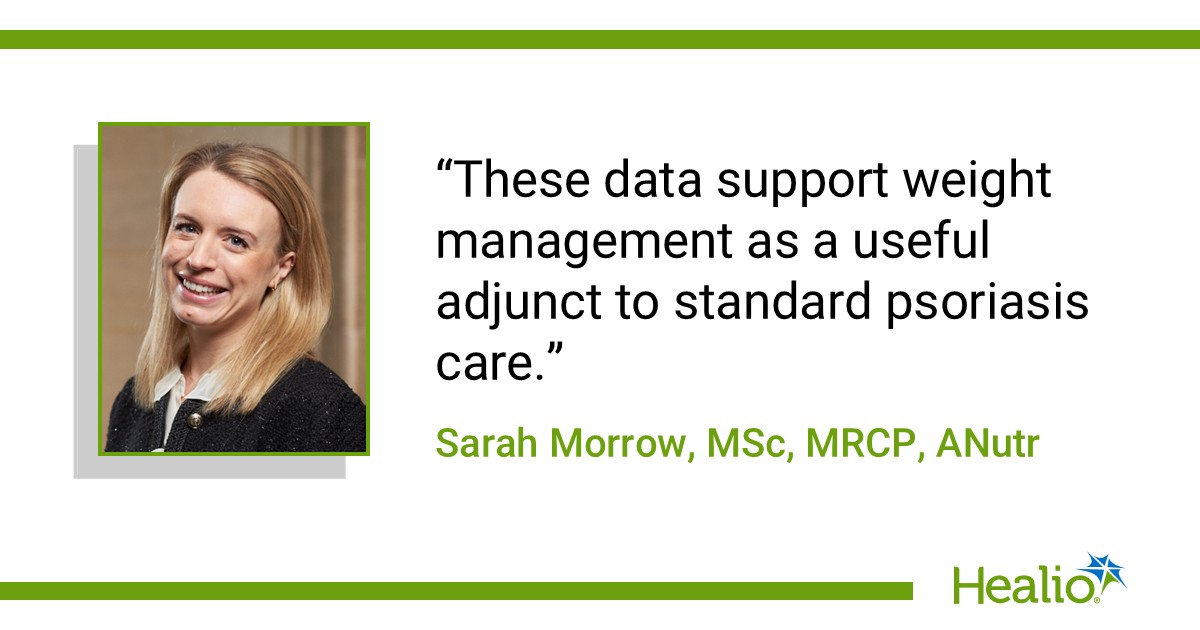
“These data support weight-management as a useful adjunct to standard psoriasis care, with potential benefits for both disease severity and quality of life,” Morrow said.
Further research is needed to test long-term durability of weight-loss interventions on psoriasis outcomes, according to Morrow. She emphasized the importance of engaging in “supportive, patient-led conversation, avoiding blame” when discussing weight-loss interventions with patients with psoriasis.
“Our next step is to work with patients and clinicians, to co-design a sensitive, patient-centered way to discuss and support weight management in routine care,” she told Healio. “We will then test an embedded conversation and referral pathway in a clinical trial.”
For more information:
Sarah Morrow, MSc, MRCP, ANutr, can be reached at dermatology@healio.com.

Ask a clinical question and tap into Healio AI’s knowledge base.
- PubMed, enrolling/recruiting trials, guidelines
- Clinical Guidance, Healio CME, FDA news
- Healio’s exclusive daily news coverage of clinical data
[ad_2]
Source link