





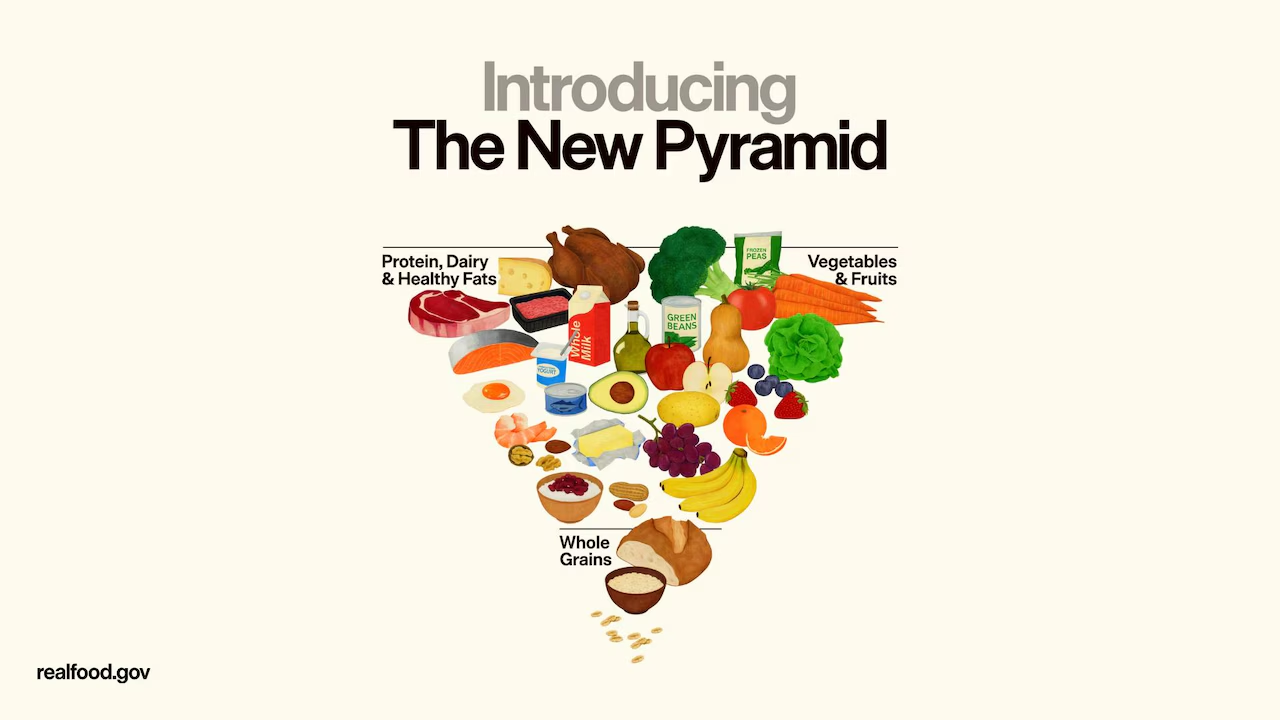
The new food pyramid repeats the core flaw of the old one: it prioritizes political and institutional comfort over metabolic and clinical reality. While the language has evolved, the guidance still avoids confronting ultra-processed foods, sugar, and individualized metabolic risk in a meaningful way. The deeper problem is not one flawed diagram but a policymaking process that is slow, politicized, and poorly aligned with patient health. As a result, public trust has eroded — and rightly so. Healthcare should move away from blind trust in government guidance toward transparent, evidence-based, and clinically grounded nutrition advice.
For decades, we were all told to follow the food pyramid. Pile on the grains, go easy on fats, and treat sugar like a rare indulgence.
It was presented as settled science, drilled into us through school lunches, hospital menus, and endless public health campaigns. And now, after years of watching obesity, diabetes, and fatty liver disease skyrocket, that advice is being quietly walked back.
The “new” pyramid—repackaged as MyPlate or the latest dietary guidelines—is supposed to fix the old mistakes. But it doesn’t get to the heart of the problem: our official nutrition advice is still shaped more by politics, industry pressure, and caution than by what actually makes people healthy.
For those of us in healthcare, this begs an uncomfortable question: If the government got nutrition this wrong for this long, why should we trust them on it now?
Let’s be clear: the original food pyramid was never purely about science. It was a compromise, hashed out between agricultural lobbies that wanted us to eat more of their products, federal agencies with conflicting goals, and committees trying to create guidelines that wouldn’t cause a political firestorm.
And that’s how we ended up with a diet built on 6–11 servings of refined carbs. It’s why fat was demonized, despite being crucial for our hormones and for feeling full. And it’s why sugar was treated as a minor problem instead of the metabolic disruptor we now know it to be.
Clinicians saw the fallout long before the policymakers did: insulin resistance climbing, type 2 diabetes showing up in younger and younger people, and chronic inflammation becoming the new normal. Yet the official advice didn’t change for a generation.
Today’s guidelines sound better. They use words like “whole grains” and “balanced plates.” But this is more of a public relations fix than a scientific one. It still tiptoes around the hard truths:
Ultra-processed food is what’s really driving our health crisis, not just a simple ratio of carbs, proteins, and fats. A bowl of sugary cereal and a bowl of steel-cut oats are not the same thing. Sugar isn’t just empty calories; it acts like a drug on our brain’s reward centers. And a one-size-fits-all diet is useless for a population with vastly different health histories and genetics.
Instead of tackling these issues head-on, the official guidance remains vague, cautious, and politically safe. That makes it less controversial, but it also makes it a lot less useful.
The real issue isn’t one bad chart. It’s the entire system that created it—a system that is fundamentally broken. Scientific evidence moves fast, but the committees that write our health policies move at a glacial pace. Industry influence is supposedly “managed,” but it’s always there. And the final recommendations are designed to be acceptable to everyone, which means they’re not optimal for anyone.
This has created a massive credibility gap. People are catching on. They know the nutrition advice keeps changing, that the official guidance often lags years behind what doctors are seeing on the front lines, and that money often has a seat at the table when “healthy” is being defined.
So when the government says, “Trust us, this new version is better,” the immediate response isn’t belief. It’s skepticism. And frankly, that skepticism has been earned.
We don’t need people to have blind faith in the government. We need them to trust evidence, their clinicians, and common sense. This means we have to start treating official guidelines as a starting point, not gospel. It means updating our recommendations the moment the evidence changes, not a decade later. It means being honest about what we don’t know instead of projecting absolute authority.
And most importantly, it means finally untangling agricultural policy from health policy.
Until that happens, every new pyramid or plate, no matter how nicely designed, will be haunted by the failures of the past. The issue isn’t just that the advice is bad; it’s that it comes from a system that still hasn’t fully reckoned with how wrong it was for so long.
So, can we ever trust the government on health again? Not in the way we used to. And maybe that’s a good thing. The goal shouldn’t be to restore blind faith. It should be to build a system that earns our trust through honesty, transparency, and results we can actually see. In healthcare, trust isn’t a slogan. It’s the only thing that matters.