





January 09, 2026
3 min read

Key takeaways:
- The American Heart Association and ACC unveiled an updated guideline for managing adult congenital heart disease.
- The guideline addresses many specific heart defects as well as barriers to lifetime care.
Professional cardiology societies have issued an updated guideline for the management of adult patients with congenital heart disease, which replaces its 2018 iteration.
The updated guideline addresses a variety of specific congenital heart diseases as well as strategies to mitigate barriers to lifetime continuous care, especially during the transition from childhood to adulthood.

The 2025 American College of Cardiology/American Heart Association Guideline for the Management of Adult Congenital Heart Disease was developed in collaboration with and endorsed by the Heart Rhythm Society, International Society for Adult Congenital Heart Disease and Society for Cardiovascular Angiography and Interventions.
“There is a growing body of literature regarding adults with congenital heart disease, and we are gaining more evidence for our therapies and treatment strategies,” Michelle Gurvitz, MD, MS, FACC, associate professor of pediatrics and program director of the adult congenital heart disease fellowship at Harvard Medical School, well-being director in the department of cardiology at Boston Children’s Hospital and chair of the guideline writing committee, told Healio. “We thought it was a good time to bring the literature together and update the prior guidelines. We still have a long way to go in learning about the adult congenital heart disease patient population and how to provide optimal care for all of our patients, but we are moving forward every day.”
In synthesizing these new recommendations, the writing committee conducted a systematic review of randomized controlled trials, registries, nonrandomized comparative and descriptive studies, case series, cohort studies, systematic reviews and expert opinion.
“There are dozens of new recommendations in the 2025 adult congenital heart disease guidelines addressing general topics as well as specific conditions,” Gurvitz said.
Topics and special conditions with new or revised recommendations included plans of care for adult congenital heart disease programs, expertise for noncardiac surgery, management of cyanosis, heart failure, transplantation, genetic screening, reproductive health, exercise and physical activity, atrial and ventricular septal defect, anomalous pulmonary venous connection, cor triatriatum sinister, congenital valvular disease, Ebstein’s anomaly and more.
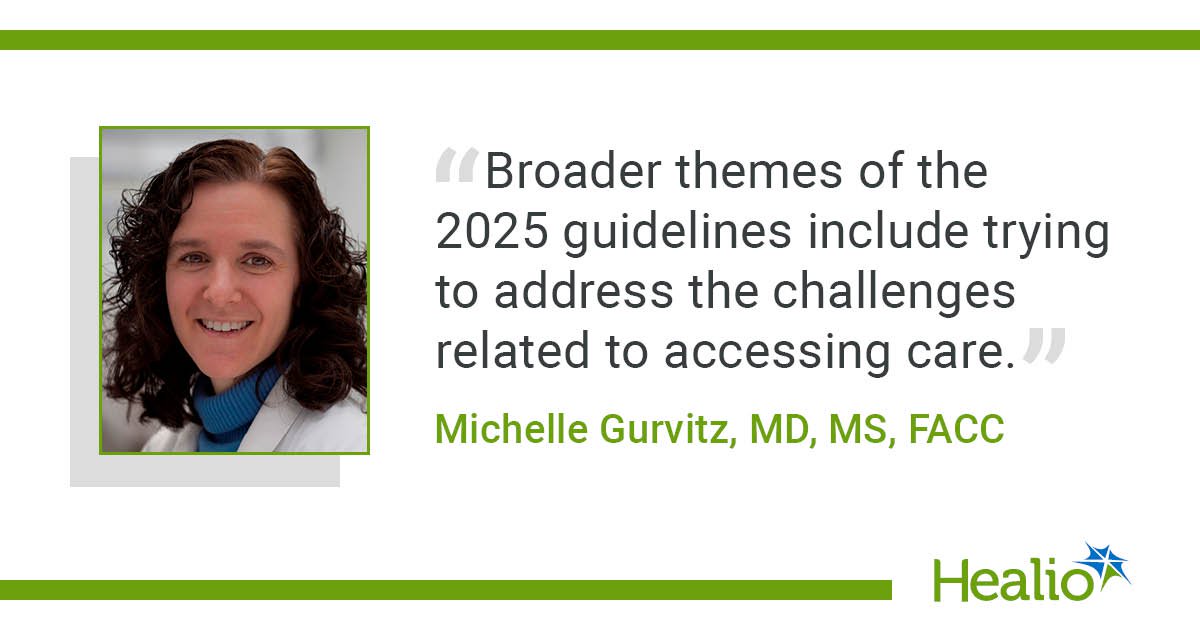
“Some of the broader themes of the 2025 guidelines include trying to address the challenges related to accessing care, recommendations for collaborative care between adult congenital specialists and other health care professionals and ensuring we continue to care for the whole patient not just the specific congenital heart condition,” Gurvitz told Healio.
The guideline recommends adults with congenital heart disease undergo routine care at dedicated adult congenital heart disease centers, and with multidisciplinary care teams to help guide decision-making.
In addition, the committee wrote that adult patients with anatomic or physiologically moderate or complex congenital heart disease who undergo procedures — cardiac or noncardiac — should have an adult congenital heart disease cardiologist as part of their care team to provide guidance for procedures, anesthesia and postprocedural management.
“While our management of adult congenital heart disease conditions has improved over time, the variety of anatomic congenital heart defects and the changing surgical approaches over time remain challenges to developing robust clinical outcomes data,” Gurvitz told Healio. “Further multicenter research collaboration and advanced research methodology will be required to continue to move the field forward. On the clinical side, there continue to be barriers to accessing care with a limited number of adult congenital heart disease specialty cardiologists and challenges with insurance coverage and costs.”
Barriers to seamless, high-quality, lifelong adult congenital heart disease care include lack of education and organization for patients, clinicians and congenital heart disease programs during the transfer from pediatric to adult care as well as lack of dedicated clinicians and programs for this patient population, according to the document.
To reduce these barriers to care, all patients with congenital heart disease receive structured, patient-centered education during transition from childhood to adulthood to reduce loss to care, the authors wrote.
In addition, the guideline recommended that congenital heart disease programs have in place transfer-of-care procedures to ensure effective handoffs of patients from pediatric to adult cardiologists.
“We are hopeful that clinicians and patients find the recommendations informative and useful and help improve care and stimulate ideas for additional research,” Gurvitz told Healio.
For more information:
Michelle Gurvitz, MD, MS, FACC, can be reached at cardiology@healio.com.

Ask a clinical question and tap into Healio AI’s knowledge base.
- PubMed, enrolling/recruiting trials, guidelines
- Clinical Guidance, Healio CME, FDA news
- Healio’s exclusive daily news coverage of clinical data