



[ad_1]
January 06, 2026
7 min read
Key takeaways:
- In New York City, kids can only receive asthma medication at school with a completed medication administration form.
- An intervention including a paperless electronic process of form submission is being tested.
To make it easier for children with asthma to receive care at school, a new study will assess the impact of making the required medication administration form available for completion online vs. on paper, according to a press release.
Marina Reznik, MD, MS, vice chair of clinical and community-based research at Children’s Hospital at Montefiore Einstein and professor of pediatrics at Albert Einstein College of Medicine, is leading this study with support from a $4.1 million NIH grant (PRAGMATIC-S).

Notably, the electronic system for the medication administration form that needs to be filled out by both the clinician and parent/guardian and then sent to the school will also be paired with support from an asthma outreach worker for patients enrolled from intervention clinics during the study.
Healio spoke with Reznik to learn more about her past research, the background for her new study and what she hopes to achieve.
Healio: Reflecting on your research focused on development and evaluation of community-, clinic- and school-based interventions to improve the health care services and outcomes for children with asthma, what findings are you particularly proud of?
Reznik: I’m particularly proud of my research in collaboration with the New York City Department of Health that took place 8 or 9 years ago. We worked on a randomized controlled trial of a one-time Integrated Pest Management (IPM) intervention in the homes of almost 400 children aged 5 to 12 years with persistent asthma.
The results of that study actually changed the city, Medicaid and health care sector policies by establishing pest control as an adjunct intervention to combat asthma inequities. It still provides services to thousands of city children with persistent asthma. Based on this study and evidence that pests are triggers of asthma exacerbation, we can refer children who have persistent asthma and exposure to pests at home through the city resource to have the integrated pest management come to their home free of charge and address their pest issues. This is an important intervention and needs to be part of our medical management of children with asthma. It’s not enough to treat with medications. We need to address other triggers in their home environment.
Another finding I’m proud of is from my NIH-funded PRAGMATIC study. It was a cluster randomized controlled trial that involved all of our Montefiore outpatient clinics. That study developed, within our electronic health record system, a tool to screen all children with asthma of all ages for the level of asthma severity or level of control at the time of a clinic visit. The screening is based on the NIH guidelines for asthma management and is a first step for the providers to manage a child’s asthma. Without knowing what the level of severity or level of control is, you don’t know how to address asthma.
In this same study, we also built decision support for providers to follow the asthma management guidelines, which was successful and showed that it improved the asthma guideline-based care that we provide in the clinic setting.
We trained all the nurses when we implemented the asthma screening tool, and now it’s part of the training for the nurses who are new to the Montefiore system. Asthma severity and control screening has become standard practice with hundreds of thousands of patients screened at the time of the clinic visit. I feel like that’s a big accomplishment because it provides a necessary first step in terms of asthma management across all of our clinics.
Healio: What is the background/motivation for the study you will be conducting with this grant?
Reznik: Children with asthma enrolled in schools in New York City are required to have a medication administration form on file with their school nurse to receive their daily controller inhaler or quick reliever medication that they would need to use for acute asthma symptoms during school hours.
This medication administration form is required to be completed by the medical provider every school year. About 30% to 50% of children with asthma attending city schools have the form on file with the school.
If a child who does not have this form on file experiences an asthma exacerbation that is not severe, the nurse can call the parent. The parent then has to bring the medication and administer it because the nurse is not allowed to give the medication without this form. If the child is really struggling and the parent cannot come to the child with the medication, then the school nurse has to call 911 and send the child to the emergency room. This leads to missed school days, delays in treatment and parents losing time from work.
Currently, these forms are only on paper. The process usually starts with the school nurse. They give this form to the student. The student brings it home to the parent. Then the parent has to get the form to the primary care doctor. Form completion during their primary care provider visit is contingent on the parent requesting this form or the primary care doctor remembering.
For New York City schools, the form is within our EHR system. But if they are in a school that’s in a neighboring town like Yonkers or in a private school, they have to bring a paper form from that school. If it’s in the EHR system, the primary care doctor has to fill it in, print it and hand sign it. After this, they give the form to the parent, and the parent has to fill out the second page and hand sign it. Then the parent has to bring this form to the school or send it to school through the child.
As you can see, this process is very cumbersome. There are a lot of handoffs between the provider, the parent and the school. Each of these steps presents a barrier to completing this form successfully and filing it with the school, ultimately limiting the care that the children can receive during school hours.
This grant builds on what we developed within the EHR system through the prior NIH-funded PRAGMATIC study.
Over the last 2 years, we have collaborated with the Office of School Health from the New York City Department of Education and a company called Hyphen. It’s a technology arm of Healthfirst, a regional health plan that serves many of our patients. As a result of this partnership, a digital platform, called ezMAF, was developed and is now integrated in our EHR system.
This digital platform allows primary care doctors to complete the asthma medication administration form during the visits with patients and electronically sign and share the form with parents. Parents can complete their section of the form on their phone, electronically sign it and transmit the form directly to the Office of School Health and the child’s school. It bypasses all the handoffs that are currently needed in the process.
Additionally, providers have access to a dashboard within our EHR system that displays the progress of the form completion. The system sends a series of automated reminders or the provider can manually send a reminder through this platform to the parents’ email to complete the form if they haven’t done that. This provides a streamlined process to increase the completion rate of these forms, as well as increase access to asthma controller inhaler and rescue medications during school hours for children.
Asthma outreach workers will also be involved in this study. These are individuals who speak the language of the community we serve and will be trained on asthma and provide care coordination and support to the families. They will be linking the primary care providers, the families and the schools. Asthma outreach workers were involved in my prior research and have been very successful with the parents receiving the care coordination and support that they need for managing their asthma at home.
Healio: What is the design of this study?
Reznik: It’s a cluster randomized controlled trial. All 18 of our outpatient clinics at Montefiore will be randomly assigned to receive the ezMAF platform to electronically complete, sign and transmit the medical administration form and the asthma outreach worker. All the sites and all the providers will have access to the asthma management decision support tool that we built before within the EHR system during the PRAGMATIC study, but we’re now updating it to the most recent guidelines.
Healio: What is the goal of this new study?
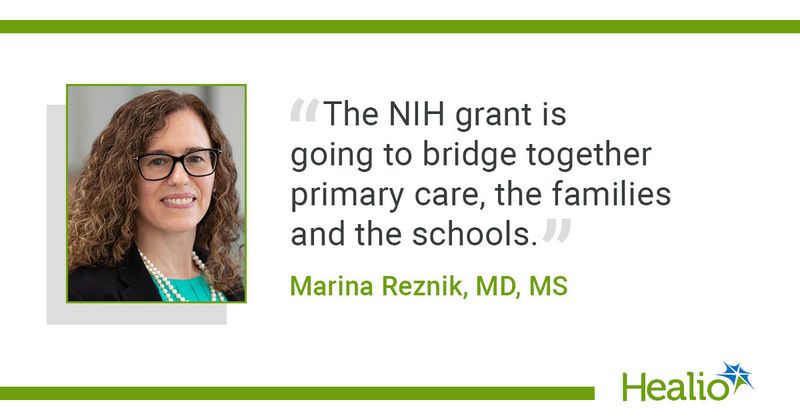
Reznik: The main goal is to address different barriers to adherence to care that we know exist on multiple levels (patient level, clinical level, school settings, etc). The NIH grant is going to bridge together primary care, the families and the schools to make sure that this guideline-based care actually happens in all these different settings.
The scale and scope of this is going to be tremendous because it is going to be implemented at all of our practices. I’m hoping it will reach patients who go to the many different schools within our neighborhood, as well as some schools even outside of the Bronx.
Notably, this study is innovative in a way that it integrates all the different settings. It’s a lot of different hurdles and barriers to bring all of these settings together and integrate them, but I’m excited about what it could mean to our patients and also our community at large. It is also innovative in using technology, which is the way of the future, and getting away from current use of paper forms.
We have tested certain aspects of the intervention, and we know it works. The question now is how can we build on that so that we can further improve the care we provide and the care that children should be receiving at school and at home? Also, how does that translate on a much larger scale beyond the children who are enrolled in the study? We may not have that answer immediately, but I hope it will offer this innovative strategy of getting the care that the children should be getting at all these settings.
For more information:
Marina Reznik, MD, MS, can be reached at mreznik@montefiore.org.
Sources/Disclosures
Source:
Healio Interviews
Reference:
Disclosures:
Reznik reports currently receiving grant support from Monaghan Medical Corporation, the NIH and Stony Wold-Herbert Fund.

Ask a clinical question and tap into Healio AI’s knowledge base.
- PubMed, enrolling/recruiting trials, guidelines
- Clinical Guidance, Healio CME, FDA news
- Healio’s exclusive daily news coverage of clinical data
[ad_2]
Source link