




[ad_1]
November 25, 2025
2 min read

Key takeaways:
- Women with thyroid dysfunction before and during pregnancy had a 2.68-fold higher risk for having a child diagnosed with autism.
- Autism risk increased with each additional trimester of thyroid dysfunction.
Women who have thyroid dysfunction both before and during pregnancy may have increased risk for having a child diagnosed with autism spectrum disorder, researchers reported in The Journal of Clinical Endocrinology & Metabolism.
“The findings of our study suggest that while adequately treated chronic thyroid dysfunction was not associated with increased autism risk in offspring, ongoing thyroid hormone imbalance, especially if continued across multiple trimesters, was,” Idan Menashe, PhD, head of the department of epidemiology, biostatistics and community health sciences, faculty of health sciences at Ben-Gurion University of the Negev in Israel, told Healio.

Menashe and colleagues conducted a retrospective cohort study of women who had a singleton birth at Soroka University Medical Center in Israel from 2011 to 2017. Women who had an ICD-9 code for hypothyroidism or hyperthyroidism in their electronic health record were defined as having chronic thyroid dysfunction. Gestational thyroid dysfunction was defined based on thyroid hormone levels during each pregnancy trimester.
There were 51,296 women in the study, of whom 8.6% were diagnosed with thyroid dysfunction. Of the study group, 1,161 had chronic hypothyroidism, 1,600 had gestational hypothyroidism, 1,054 had both chronic and gestational hypothyroidism, 100 had chronic hyperthyroidism, 376 had gestational hyperthyroidism and 15 had chronic and gestational hyperthyroidism.
Offspring were diagnosed with autism spectrum disorder at a median age of 4.6 years. There was no difference in the incidence of autism spectrum disorder between women with any thyroid dysfunction and those with normal thyroid function.
Women who had both chronic and gestational thyroid dysfunction had higher risk for offspring with autism spectrum disorder than women with normal thyroid function (adjusted HR = 2.68; 95% CI, 1.52-4.72). Similarly, women with both chronic and gestational hypothyroidism had increased risk for children with autism spectrum disorder than women with normal thyroid function (aHR = 2.61; 95% CI, 1.44-4.74).
Each additional trimester of thyroid dysfunction during pregnancy raised the risk for offspring with autism spectrum disorder for women with gestational hypothyroidism only (aHR = 1.39; 95% CI, 1.16-1.68) and those with both chronic and gestational hypothyroidism (aHR = 1.28; 95% CI, 1.02-1.93). The risk for having offspring with autism spectrum disorder was highest among women who had gestational hypothyroidism through all three trimesters of pregnancy. Menashe said the relationship between longer duration of maternal thyroid dysfunction and increased risk for autism spectrum disorder in offspring was surprising.
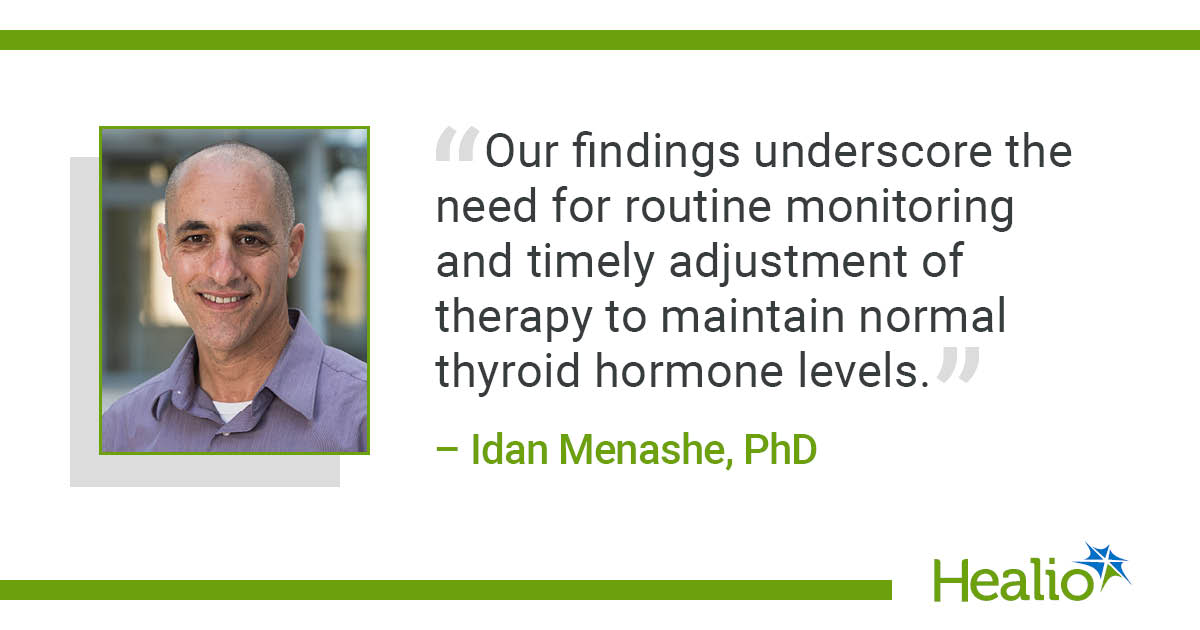
“Our findings underscore the need for routine monitoring and timely adjustment of therapy to maintain normal thyroid hormone levels throughout pregnancy,” Menashe said.
More research assessing the mechanisms of how abnormal thyroid hormone levels affect fetal neurodevelopment is needed, Menashe said.
For more information:
Idan Menashe, PhD, can be reached at idanmen@bgu.ac.il.
Perspective

This study adds to a growing body of epidemiologic evidence (Kaplan ZB, et al. Thyroid. 2024;doi:10.1089/thy.2023.0391) suggesting that maternal gestational hypothyroidism is linked to autism spectrum disorder (ASD) risk in offspring. This retrospective Israeli cohort found a more than twofold increased risk for ASD diagnoses in children whose mothers had been hypothyroid both before and during pregnancy compared with the children of euthyroid women. Having hypothyroidism only prepregnancy or only during pregnancy was not associated with increased child ASD risk, suggesting that risk increased with a longer duration of uncontrolled hypothyroidism.
Study strengths included thyroid function test measurement at multiple time points in gestation and a lengthy duration of follow-up. However, the study was limited by its retrospective design. Potential confounders including maternal iodine status, socioeconomic status and the presence of thyroid autoimmunity were not assessed, and information about levothyroxine treatment was not ascertained. Effects of isolated maternal hypothyroxinemia were not examined. The limited number of ASD cases in children of hyperthyroid mothers did not allow for robust analysis in that group. We already know that adequate treatment of overt gestational hyperthyroidism is essential to improve both obstetric and child developmental outcomes. While this study suggests that even subclinical hypothyroidism in pregnancy may increase child ASD risk, whether levothyroxine treatment mitigates this risk has not been assessed in clinical trials.
Elizabeth N. Pearce, MD, MSc
Healio | Endocrine Today Editorial Board MemberProfessor of MedicineSection of Endocrinology, Diabetes and NutritionBoston University Chobanian & Avedisian School of Medicine
Disclosures: Pearce reports no relevant financial disclosures.

Ask a clinical question and tap into Healio AI’s knowledge base.
- PubMed, enrolling/recruiting trials, guidelines
- Clinical Guidance, Healio CME, FDA news
- Healio’s exclusive daily news coverage of clinical data
[ad_2]
Source link