



[ad_1]
October 17, 2025
4 min read
Key takeaways:
- The Kids Mobile Medical Clinic has offered universal asthma screenings since 2021.
- Screenings also include home environmental risks.
- 7.8% of all children screened had a subsequent asthma diagnosis.
DENVER — By screening all children during routine well visits and asking about potential environmental triggers in the home, clinicians identified additional asthma cases, according to study findings presented here.
This early diagnosis can lead to more effective treatment and better outcomes, Janine Rethy, MD, MPH, pediatrician researcher and divison chief of Community Pediatrics at MedStar Georgetown University Hospital, and colleagues wrote on their poster presented at the American Academy of Pediatrics (AAP) National Conference & Exhibition.

Data derived from Ganacias K, et al. Screening for asthma and related environmental risks in pediatrics. Presented at AAP National Conference and Exhibition; Sept. 26-30; Denver.
“We have a high prevalence of asthma in the community we serve in [Washington, D.C.] for a variety of reasons. We also know from the literature that asthma is often underdiagnosed or diagnosed late,” Rethy told Healio.
“So, we decided to start universal asthma screening at all well child checks, which is not the norm, but makes sense in our population with a high prevalence,” she said.

Janine Rethy
The MedStar Health Kids Medical Mobile Clinic (KMMC) integrated the Asthma Risk and Control Screen (ARCS) into its universal screenings in January 2021. Reported coughing, shortness of breath at night, previous inhaler use or exercise intolerance due to breathing difficulty indicated a positive result.
“We wanted to find out if with this screening, we were identifying children with asthma who may have otherwise been missed. We already screened for housing quality as part of our universal Social Determinants of Health screening,” Rethy said.
“Yes” and “maybe” responses to having seen mold, bugs, mice, rats, peeling paint or water leaking at home on the KMMC Social Determinant of Health Screening indicate poor housing quality.
“But in this study, we wanted to use these data to take a look at the prevalence of poor housing quality in this population and particularly in children with asthma,” Rethy said.
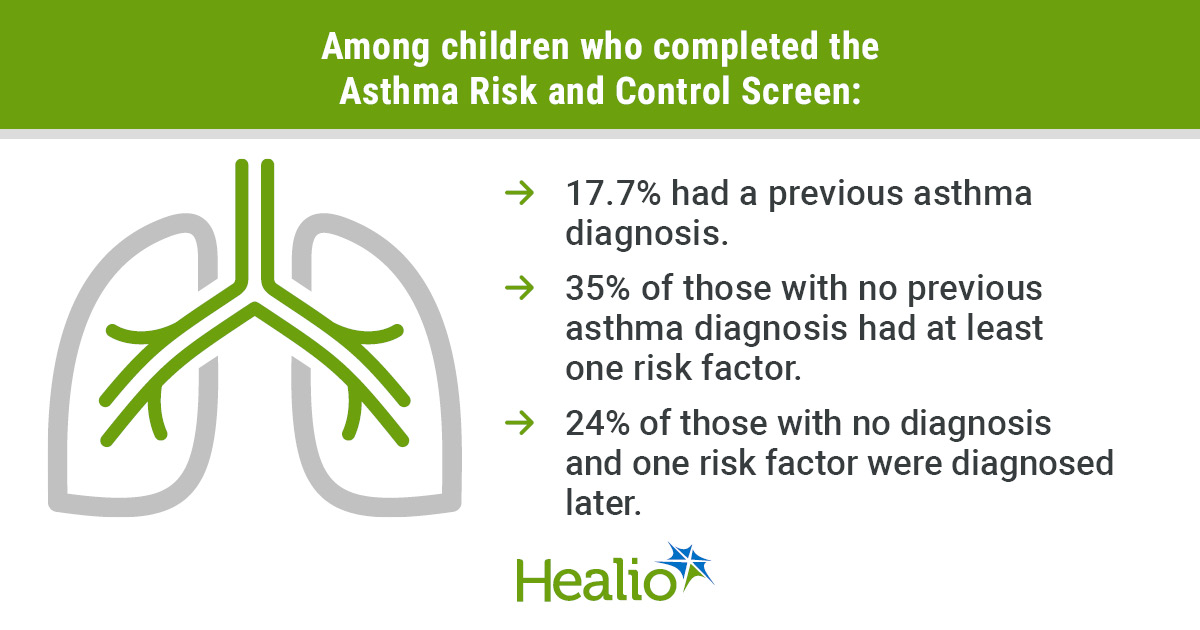
The study included 650 children (average age, 10.7 years; 92% on Medicaid; 96% African American) who completed at least one ARCS. This cohort included 17.7% with a previous asthma diagnosis based on ICD-10 codes.
“During well child visits, we were able to pick up a lot of children who had asthma who were not previously diagnosed utilizing our universal screener,” Rethy said.
Among children with no previous asthma diagnosis, 35% (n = 212) reported at least one asthma risk factor per the ARCS, and 24% (n = 51) of them subsequently were diagnosed with asthma after further clinical findings, representing 7.8% of the full cohort.
“For every 12.75 children we screened, we were able to identify one case of previously undiagnosed asthma, which is pretty good,considering the screening is short and noninvasive,” Rethy said.
Also, 41% of the full cohort screened positive for poor housing quality, including 38% of the children with a prior asthma diagnosis and 52% of the children who had asthma symptoms but no diagnosis yet.
Based on these findings, the researchers concluded that diagnoses can improve with routine screenings for asthma symptoms among populations where asthma prevalence is high, adding that poor housing quality is prevalent among these populations as well.
Optimal treatment for these populations, the researchers said, is enhanced with early diagnosis, appropriate management and mitigation of environmental triggers.
“Our clinic has developed a partnership with a home visiting program to remediate environmental triggers for children with asthma, as well as a medical-legal partnership to help advocate for safe and healthy housing,” Rethy said.
Rethy encouraged primary care pediatricians in communities with high prevalence of asthma to consider universal screenings to identify cases that they otherwise may miss.
“Asthma is underdiagnosed because families may not think of some of these symptoms as possibly being related to asthma,” Rethy said.
Or, she continued, these children may be seen across multiple EDs or urgent care facilities and treated with asthma medications, but these providers might not tell these families that asthma is possible because they do not know the child’s full symptom history.
“Earlier asthma diagnosis and appropriate treatment can make a big difference for children’s ability to play, exercise, sleep and participate fully in school, as well as long term lung function,” Rethy said.
Screening for home environmental triggers that may be common in these communities also is worth considering, she added.
“As in our population, communities with high rates of asthma often also have housing conditions with common triggers such as rodents, roaches and mold,” she said. “This opens the discussion with the family around a holistic approach for decreasing frequency and severity of asthma exacerbations.”
Rethy said that her clinic’s home visiting and legal partnerships have been important on its path to safer, healthier housing for many families.
However, Rethy cautioned that this small study in an urban setting might not be generalizable to other settings, so the next step would be to validate the asthma screening tool and study the impact of improving housing quality for these children.
“At the policy level, it will be important to have adequate reimbursement for the universal screenings in the primary care setting, as well as for care coordination around helping families attain safe and healthy housing,” she added.
For more information:
Janine Rethy, MD, MPH can be reached atjanine.a.rethy@gunet.georgetown.edu.
Perspective

As an attendee and faculty at the AAP National Conference & Exhibition, I am so happy to hear that this abstract was included in this discussion. The authors present a practical approach to overcome the known issue with underdiagnosis of asthma in high-risk populations, where we often see a discrepancy between known asthma prevalence and actual diagnosis.
Routine screening through a medical system that may provide immediate diagnosis, treatment and trigger mitigation is the right way to ensure that screenings are properly handled to reach an accurate diagnosis. One must be careful when screening positive for asthma, as many causes for asthma symptoms could present similarly, such as an upper respiratory infection, among others.
Tag-teaming with a mobile clinic is something we have done in Chicago with the Mobile Care Chicago Asthma and Allergy Van through school-based screening and assessments. We have found this works very well, and I am delighted to see others have found similar results. I think this should be a model for community-driven asthma interventions to ensure we have the correct diagnosis and treatment plan across the age spectrum for those with asthma.
Andrea Pappalardo Wlochowicz, MD, FAAAAI, FACAAI
Disclosures: Pappalardo Wlochowicz reports currently having research grants from the NIH and the Illinois Department of Public Health (contracted through Respiratory Health Association), Food Allergy Research & Education (FARE) and the American College of Allergy, Asthma & Immunology. She recently completed research grant funding within the last 24 months from the Agency for Healthcare Research and Quality, American Lung Association, FARE and the ACAAI. She serves as a consultant for OptumRx, Northwestern University and FARE. Within the last 24 months, she has received an honorarium for knowledge dissemination/lectures through the Illinois Critical Access Hospital Network, the Wisconsin Allergy Society, FARE and the AAP.
Perspective

These findings are significant, as this was a unique approach to help identify children with asthma whose diagnosis may not have been caught otherwise.
Identifying a specific community with high rates of asthma and then screening all children for asthma and home environmental triggers during well checks found many cases that would have otherwise been missed.
In my experience raising three children with asthma, it was difficult to get an asthma diagnosis. Since asthma and respiratory infections can look and sound similar, parents may be told that their child is just sick.
Screening a child during a well check may reveal symptoms that can’t be blamed on a child being sick.
When my son was 5 years old, I suspected he had asthma and asked the pediatrician about it. But I was told my son just had a virus. A short time later, he was hospitalized, and I found out my son had asthma from a respiratory therapist in triage.
Since asthma is the most common chronic disease among children, and the No. 1 cause of missed school days, this disease could be caught early during screenings at well child visits.
Using the Asthma Control Test or another validated tool may result in finding previously unknown cases. Answering the questions from the Asthma Control Test may help parents understand what to watch for. Parents may realize it’s not normal for their child to cough, wheeze, be short of breath and be woken up at night or early morning with those symptoms.
Andrea M. Jensen, CHES, AE-C
Disclosures: Jensen reports no relevant financial disclosures.
Sources/Disclosures
Source:
Ganacias K, et al. Screening for asthma and related environmental risks in pediatrics. Presented at AAP National Conference & Exhibition; Sept. 26-30, 2025; Denver.
Reference:
Disclosures:
The authors report no relevant financial disclosures.
[ad_2]
Source link