


[ad_1]
September 10, 2025
4 min read
Key takeaways:
- Successful treatment of anaphylaxis symptoms with a single dose of neffy 2 mg was found in 89.2% of patients in a real-world study.
- This is comparable to the success rate of injectable epinephrine.
A single dose of neffy epinephrine nasal spray resulted in successful treatment of anaphylaxis symptoms during oral food challenges in most patients, according to results from a phase 3 study and a real-world study.
The phase 3 study is published in The Journal of Allergy and Clinical Immunology: In Practice and the real-world study has been accepted for publishing in Annals of Allergy, Asthma and Immunology, according to a press release from ARS Pharma.

“These data provide real-world assurance that neffy can effectively treat acute allergic reactions,” Thomas B. Casale, MD, member of ARS Pharma’s scientific advisory board and professor of medicine and pediatrics and chief of clinical and translational research in the division of allergy and immunology at USF Health Morsani College of Medicine at the University of South Florida, told Healio.
In an open-label, single-period, single-dose phase 3 study, Motohiro Ebisawa, MD, PhD, and colleagues evaluated 15 Japanese patients aged 6 to 17 years with a food allergy and at least one moderate (grade 2) oral food challenge-induced anaphylaxis symptom to analyze the efficacy of neffy (ARS Pharma) epinephrine nasal spray given after symptom onset.
A patient’s weight determined if they received neffy 1 mg (15 kg to < 30 kg) or 2 mg (≥ 30 kg), according to the study. The 1 mg group included six patients (median age, 7.3 years; 83% girls; median weight, 18 kg; median BMI, 14 kg/m2), and the 2 mg group included the remaining nine patients (median age, 12.8 years; 44% girls; median weight, 40 kg; median BMI, 17 kg/m2).
As Healio previously reported, the FDA approved neffy for emergency treatment of type 1 allergic reactions, including anaphylaxis in pediatric and adult individuals weighing at least 66 pounds, in August 2024.
Casale told Healio this decision was based on extensive pharmacokinetic and pharmacodynamic studies.
“As with previous epinephrine delivery devices, the FDA asked for data showing that after delivery of neffy the epinephrine blood levels and expected changes in pulse and blood pressure were similar to those achieved with injectable formulations of epinephrine,” Casale said. “neffy performed as expected with blood levels of epinephrine bracketed by those achieved with EpiPen [Viatris] and a needle and syringe along with increases in pulse and blood pressure compatible with the epinephrine levels measured.”
More recently, the FDA approved neffy 1 mg for treating anaphylaxis and other type 1 allergic reactions in children aged 4 years and older.
Results
Researchers found that a second dose of epinephrine for the initial reaction was not needed in any of the assessed patients. At the 2 hour and 45-minute mark from the time given neffy, one patient experienced a biphasic reaction (headache, dyspnea and numbness of extremities) that was resolved with intramuscular epinephrine.
Within 5 minutes of neffy administration, the study reported that the mean grade of gastrointestinal symptoms (n = 7), respiratory symptoms (n = 8) and skin and mucosal symptoms (n = 2) went down. In contrast, the mean grade of cardiovascular symptoms (n = 1 with tachycardia) was not reduced until after the 20-minute mark. Casale told Healio that this continuous symptom “could be attributed to the administration of epinephrine itself as it is supposed to increase heart rate.”
When divided by neffy dose, both groups had a lower mean grade of symptoms within 5 minutes of administration. According to the study, symptom resolution was seen at a median of 16 minutes in the total cohort, 15 minutes in the 2 mg group and 22.5 minutes in the 1 mg group.
In terms of adverse events, researchers observed at least one event in 10 patients (66.7%) and an event deemed treatment-related in six patients (40%). They further noted that three patients (20%) experienced a tremor not induced by the OFC and two patients (13.3%) experienced nasal mucosal erythema not induced by the OFC.
Real-world data
Following this phase 3 study and other smaller studies that yielded positive results in the treatment of allergic reactions precipitated by OFC or immunotherapy and in the treatment of urticaria, Casale told Healio researchers performed a larger real-world study to demonstrate how neffy performs in real clinical situations.
“In the neffy experience study, health care providers were given samples of neffy and asked to use them to treat acute allergic reactions from either allergy immunotherapy or oral food challenges,” Casale said.
This study included 545 patients treated with neffy 2 mg, and successful treatment with a single dose of neffy was found in 89.2% (n = 486) of patients, according to the release.
“These data are remarkably similar to multiple studies with injectable epinephrine showing that 89% of patients can be effectively managed with a single dose of injected epinephrine using a needle and syringe or autoinjector,” Casale told Healio.
Casale added that it is “very reassuring” that this similarity between injectable epinephrine and neffy exists.
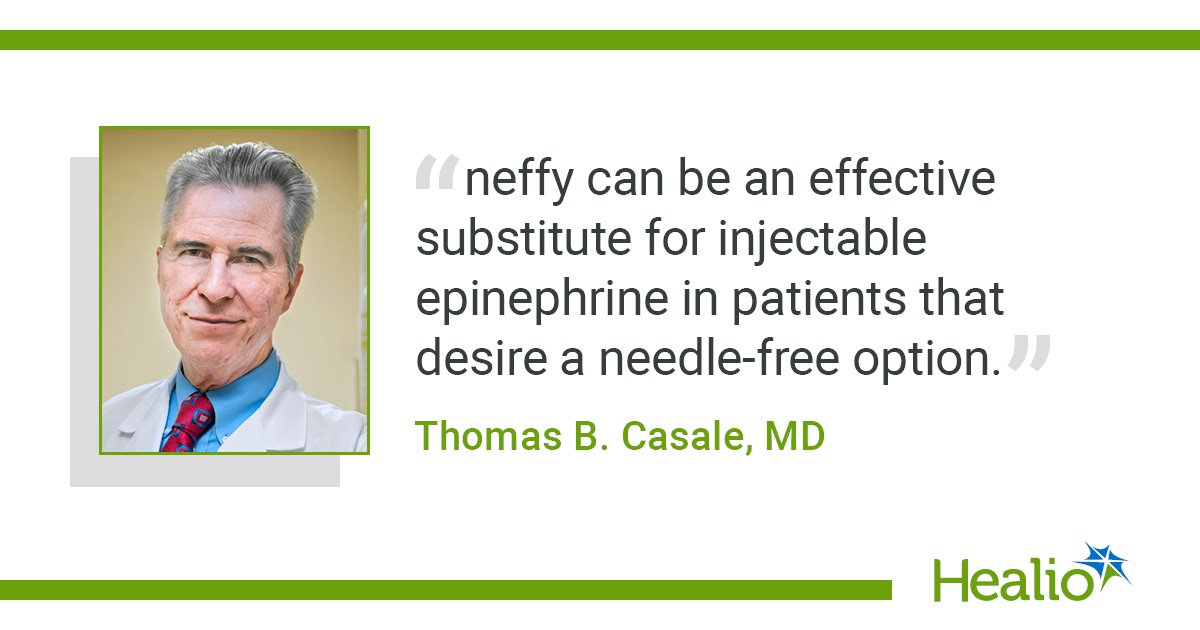
“Given the large number of patients and the similar findings to those achieved with injectable epinephrine in previous studies, the data should provide assurance to providers that neffy can be an effective substitute for injectable epinephrine in patients that desire a needle-free option,” Casale said.
“Since most patients do not fill a prescription for injectable epinephrine, and those that do either do not carry them or do not appropriately use them delaying the administration of epinephrine, providing an easier to carry and needle-free option is a step forward in the management of anaphylactic reactions by physicians and patients,” Casale told Healio. “Indeed, self-management by patients will be much easier and administration to young children by parents and guardians will also be facilitated.”
Looking ahead, Casale outlined that future research will focus on the long-term effectiveness and safety of neffy in clinical practice.
Reference:
For more information:
Thomas B. Casale, MD, can be reached at tbcasale@usf.edu.
[ad_2]
Source link