

[ad_1]
August 15, 2025
3 min read

Key takeaways:
- Maintaining a strong professional network is vital to keep up with innovations in dry eye care.
- Medical science liaisons can offer insights into their products that improve patient outcomes.
Optometrists who focus on ocular surface disease form a uniquely collaborative community.
Dry eye disease, with its multifactorial and often ambiguous presentation, requires a nuanced approach. Given this complexity, many of us regularly consult colleagues to share clinical pearls, discuss new technologies and troubleshoot challenging cases. These professional relationships serve as a cornerstone of success when incorporating novel therapies or diagnostics into clinical practice.

Collaboration extends beyond clinical colleagues. Industry partners — particularly medical science liaisons (MSLs) — offer in-depth insights into the development and clinical applications of the products they support. I have found MSLs to be invaluable when navigating the clinical relevance of emerging treatments. Their familiarity with the data allows for meaningful dialogue that enhances our decision-making and ultimately benefits patient outcomes.
As innovation in dry eye care accelerates, maintaining a strong professional network becomes increasingly vital. I have personally benefited from the shared experience of colleagues and witnessed the avoidable missteps of practitioners who attempt to implement change in isolation.
Building a professional network
Engagement in professional organizations is one of the most effective ways to build relationships in this subspecialty. The American Academy of Optometry, particularly through its Anterior Segment Section, has been instrumental in my own professional growth. Similarly, the American Optometric Association and various regional and subspecialty groups provide platforms for connection, education and mentorship.
Maximizing the value of meetings and conferences involves more than attending continuing education lectures. Seek out networking opportunities and ask thoughtful questions during clinical symposia, especially around what treatments have or have not worked and why. These conversations not only deepen understanding but also foster trusted professional relationships.
MSLs are frequently present at these events. Early in my career, I connected with them through sales representatives, who introduced me to the scientific side of the product portfolio. Reaching out directly to companies for research-related inquiries is still an excellent approach to engage with an MSL.
From insight to evidence
Peer advice and manufacturer insight are useful starting points, but independent evaluation of the evidence is essential. Whether implementing novel therapies or relying on core interventions, clinical decisions should be rooted in peer-reviewed data.
Foundational dry eye therapies like warm compresses, artificial tears and nutraceuticals remain relevant. For example, literature supports maintaining therapeutic heat for 5 to 15 minutes during warm compresses (Lee), and I recommend a practical range of 5 to 10 minutes based on my experience. While artificial tears do not fully replicate the natural tear film, evidence supports their efficacy in improving ocular surface hydration (Craig et al.). I prefer preservative-free formulations based on both clinical and safety profiles (Baudouin et al.).
Delivering advanced dry eye therapies
Advanced dry eye disease management often begins with further inflammation control and progresses toward enhancing natural tear production. Available therapies include thermal pulsation, intense pulsed light, low-level light therapy, punctal occlusion, scleral lenses, autologous serum tears, and immunomodulatory agents such as cyclosporine or lifitegrast. The scope of practice for optometrists may vary by state, which sometimes limits implementation, but collaboration with ophthalmology or compounding pharmacies can bridge these gaps.
Early adopters of emerging technologies can be excellent resources, though it is important to differentiate between those driven by innovation and those drawn to novelty. A strong professional network helps identify which colleagues provide reliable, clinically relevant guidance.
Progress through partnership
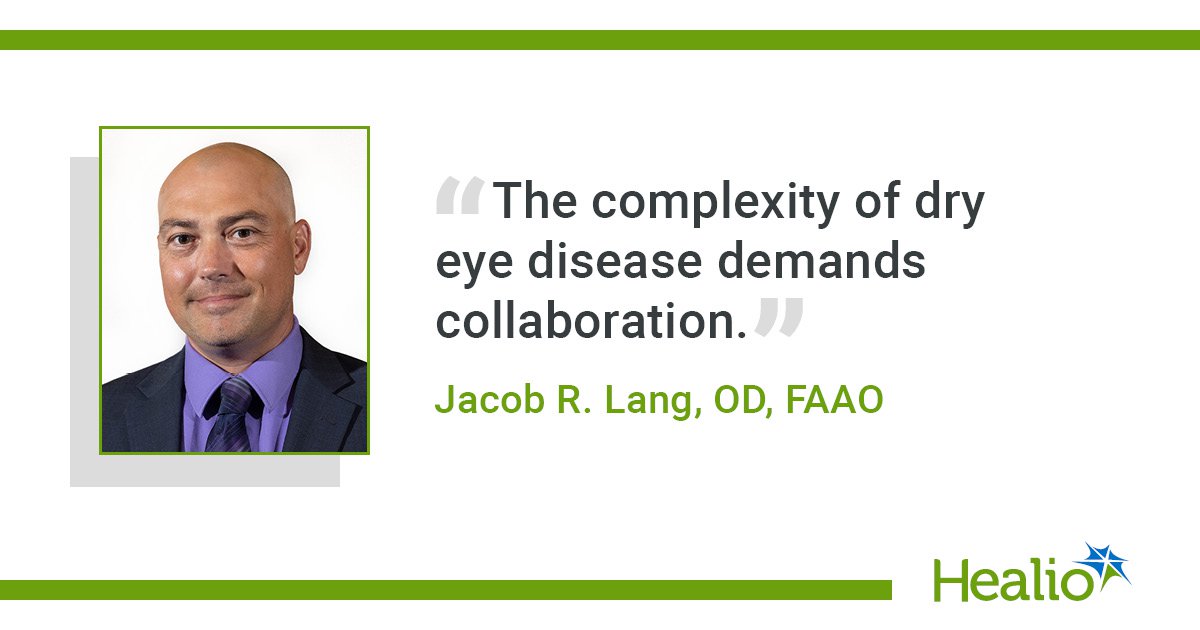
The complexity of dry eye disease demands collaboration. While optometry continues to evolve and subspecialize, we must recognize that no single provider can address every patient’s needs. Professional relationships — whether with colleagues or industry experts — enable us to provide higher-quality, more comprehensive care.
As our field advances, our collective success will increasingly depend on how effectively we work together. By engaging with others, embracing innovation and critically evaluating evidence, we ensure our patients receive the best care modern optometry can offer.
References:
For more information:
Jacob R. Lang, OD, FAAO, of Associated Eye Care in Stillwater, Minnesota, can be reached at jlang@associatedeyecare.com.
Sources/Disclosures
Collapse
Expert Perspective
Disclosures:
Lang reports being a speaker/consultant for AbbVie, Alcon, Sun Pharma, Tarsus and Viatris/Oyster Point and being a consultant for AescuelaTech, Alcon/Aerie, Aldeyra, AOS, Avellino, Bausch + Lomb, Dompe, Envision Biomedical, Horizon, Kala, Nordic Pharma, Novartis, Ophthalmic Resources Partners Orasis, ScienceBased Health, Scope, Sight Sciences, Thea Pharma, Trukera and Zeiss.
[ad_2]
Source link